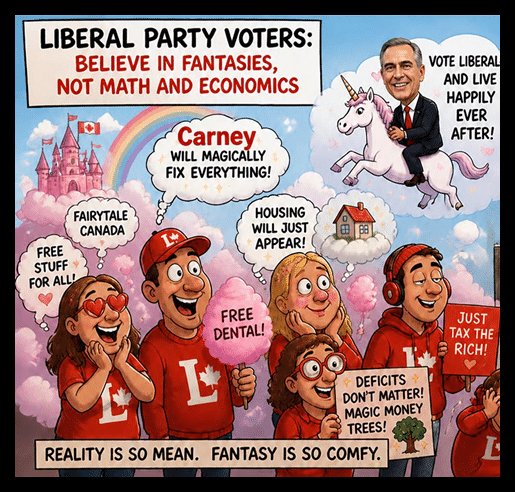
Canadian Liberals: The Masters of Magical Thinking
Oh, the proud members of the “Elbows Up” Gullible Liberal Maple Leaf Brigade!
These folks treat every campaign promise like a sacred hymn, sung by politicians who couldn’t tell the truth if it bit them on the nose. The Liberal loyals gather in clusters, nodding along to speeches that promise endless sunshine and free unicorns. Reality? That’s for the unenlightened. Their loyalty remains ironclad, even when the facts pile up like dirty laundry after a long weekend. Short and sweet: they buy the whole package every time.
Picture a group so devoted they would defend a melting iceberg if their leader called it a refreshing water feature. The brigade marches on, blinders firmly attached, ignoring any evidence that might suggest their heroes have clay feet. Or clay brains. Either works.
Years pass, scandals erupt, budgets balloon, yet the brigade holds steady. It’s almost admirable, if admiration included a hefty dose of head-shaking disbelief. The Liberal gullible redefine commitment by sticking to sinking ships while insisting the water is just a temporary inconvenience.
Why Trusting Liars Feels Like Patriotism

Trusting liars has become the ultimate badge of honor in Canada. Somehow, swallowing tall tales equates to loving the country more than the next guy. If a polished speaker claims the sky is green, the Gullible Liberal Maple Leaf Brigade salutes and starts painting their roofs to match.
It starts innocently enough. A smooth voice delivers assurances about better days ahead, ignoring the empty coffers and rising costs. The listeners clap harder, convinced that doubt equals disloyalty. Questioning the narrative? That’s practically treason in their book.
The Gullible Liberal Maple Leaf Brigade feel a warm glow of national pride every time they accept another whopper. “He’s looking out for us,” they say, while the numbers scream otherwise. Liars thrive in this environment because the audience wants so badly to believe.
The cycle repeats with each election cycle. Fresh faces or old ones recycled, the stories grow taller. Supporters double down, calling skeptics mean-spirited or worse. Patriotism here means never admitting the emperor left his clothes at the dry cleaner and forgot to pick them up.
The Gullible Liberal Maple Leaf Brigade invent reasons why the latest falsehood was actually a misunderstood stroke of genius. Context, they cry. Always more context needed, until the original lie disappears under layers of excuses.
Inventing Perfect Worlds Over Coffee

Chic coffee shops buzz with grand designs for flawless societies. Steam rises from cups as voices paint pictures of equality without effort, prosperity without production, and harmony without any messy human nature getting in the way. Everyone gets a living wage for existing. Housing appears magically. Energy stays cheap forever because wishes make it so. Details like incentives or trade-offs? Those spoil the mood.
Conversations stretch for hours. Someone suggests taxing the successful into oblivion to fund the dream. Another nods. No one mentions who pays when the productive stop producing. That would harsh the vibe. They leave the cafe energized, ready to vote for whoever promises to build this dreamland first.
Actual results from past attempts? Irrelevant history from lesser minds. The perfect world exists already in their heads, and any politician who mirrors it earns lifelong devotion. Reality checks bounce off like rubber balls. Floods of migrants strain services? Just temporary growing pains in paradise. Crime spikes? A statistical blip on the road to bliss. The invented world stays pristine, coffee after coffee, year after year.
Economics as Optional Fan Fiction

Son: Hey dad, what’s math?
Father: I don’t know, son. We’re Liberals.
Economics turns into pure storytelling for this crowd. Supply and demand sound like plot holes best ignored. Budgets become choose-your-own-adventure books where spending has no consequences and debt vanishes in the final chapter. They cheer policies that print money faster than a counterfeiter on deadline.
Inflation? A myth spread by greedy corporations. Housing shortages from restricted supply? No, just not enough government intervention yet. The fan fiction writes itself with each new announcement. Keep it simple: numbers are optional decorations.
Longer explanations get dismissed as heartless. Why learn about opportunity costs when feelings provide clearer guidance? A leader announces billions for pet projects, and the Gullible Liberal Maple Leaf Brigade celebrate the compassion. Who cares if the money comes from future generations or higher prices today?
They craft elaborate backstories for why deficits create wealth. Magic multipliers turn every public dollar into ten private ones, somehow. Evidence from places that tried this and crashed? Those were different conditions, wrong people, bad timing. Their version will succeed because the intentions glow brighter.
Markets get cast as villains in this ongoing saga. Prices rise due to corporate greed alone, never from floods of cheap credit or regulatory thickets. The story comforts, so it sticks. Why update the plot with messy data when the current draft feels so righteous?
Math Class Was for Other People
Basic arithmetic skipped the curriculum for many in the brigade. Adding up campaign costs versus available revenue feels unnecessary. If the total exceeds the income, just borrow more and call it investment. Easy.
They support plans where expenses grow without bound while revenues stay flat or shrink through higher taxes that somehow don’t reduce activity. The calculator stays in the drawer. Mental math involves hoping hard enough that the figures balance.
Tiny reminder: two plus two still makes four.
Graphs showing wage stagnation amid soaring living costs get waved away. “Focus on the equity,” comes the reply. Percentages confuse when they contradict the preferred outcome. A 20 percent rise in one area and 50 percent in another? Average it somehow to claim progress.
School memories of fractions and decimals fade into oblivion. Now percentages appear only to support the cause. “Most people agree,” they claim, citing surveys of their friends. Sample sizes and margins of error belong to boring specialists.
When confronted with clear tallies of waste or failure, the response involves changing the subject to compassion scores. Math becomes a tool of oppression in their eyes, wielded by those who refuse to dream big. Better to count feelings than dollars.
Changing Minds Only Happens to Someone Else

Flexibility of thought applies exclusively to opponents. The brigade remains fixed, a monument to consistency no matter the mounting contradictions. New information slides off like water on a well-waxed car to the Gullible Liberal Maple Leaf Brigade. They demand others evolve with the times while planting their own feet in concrete poured decades ago. A policy fails spectacularly? The failure proves it needed more funding and stronger belief. Never a flawed premise. Short take: stubbornness wears a halo here.
Debates turn into monologues. Evidence piles high on one side, yet the conclusion stays identical. “You just don’t get it,” they explain patiently to anyone presenting counterpoints. Getting it means agreeing completely. Over time, this rigidity hardens into identity. Admitting error would unravel the self-image of being the smart, caring ones.
So facts become fake, messengers get smeared, and the original position stands taller. Other people change their minds because they lack conviction. The brigade has conviction in spades, even when it leads nowhere useful. Friends and family who shift views face quiet exile or loud lectures from the Gullible Liberal Maple Leaf Brigade. Loyalty tests never end. The group reinforces itself, echoing the same lines until doubt sounds foreign and dangerous- worse, Conservative.
An Ode to Eternal Political Stubbornness
Praise be to the unyielding stance of the Gullible Liberal Maple Leaf Brigade that weathers every storm of proof.

Eternal political stubbornness deserves its own anthem, sung loudly at rallies and dinner tables alike. It keeps the faith alive when all else collapses. This quality ensures no lesson ever sticks. Governments expand, results disappoint, yet the call goes out for still more of the same. The ode writes itself through repeated actions: vote the same way, defend the same lines, dismiss the same critics. Permanence beats progress every election.
Verses recount the glory of ignoring budgets that never balance and social metrics that slide backward. Choruses celebrate the moral superiority felt while outcomes worsen. Bridges, both literal and figurative, crumble under neglect, but the song continues unbroken.
Leaders come and go, some exiting under clouds of broken vows, yet the support base hums the familiar tune. Alternatives get painted as extreme or cruel, leaving only the one true path. In the end, this dedication creates a closed loop of affirmation.
Outside voices fade. Internal doubts get punished. The maple leaf waves forever over a crowd convinced of its righteousness, math-free, fantasy-fed, liar-trusting, and proudly unchangeable.
The Gullible Liberal Maple Leaf Brigade marches on indefinitely, audiences laughing or crying depending on their seat.

This article was generated (mostly) by the Grok 4 A.I. Model https://x.ai/grok
PAPERBACK RETAILERS
Amazon
Books A Million
Alibris
Abe Books
Bookshop
Life’s Sacred Questions? An Expansive Exploration
Philosophical Fragments Of Your Ancient Name takes you on a journey of self-discovery from the edges of our solar system to the sanctuary of your soul – and beyond! The book explores four dimensions of the human mind: scientific, social, theological and mystic.
This thought-provoking book pulls no punches in scrutinizing modern society. Environmental debates like climate change and our impact on the planet are dissected with nuanced arguments. Technology’s effects on our psychology and the growing inequality in our social systems are put under the microscope. The book boldly walks the line between rationalism and spiritual experience, challenging fixed views on both sides.
Check out this book here!