
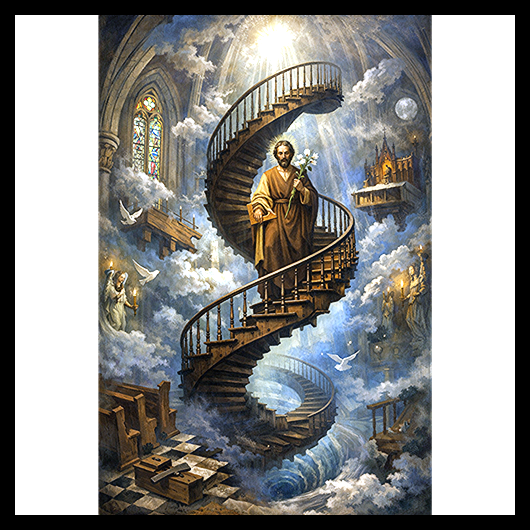
Faith, Mystery, and the Spiral That Defies Explanation
Tucked away in the historic heart of Santa Fe, New Mexico, Loretto Chapel stands as a quiet rebuke to the ordinary. Built between 1873 and 1878 in the Gothic Revival style by the Sisters of Loretto, the small chapel was meant to serve as both a place of worship and a finishing school for young women. Its soaring ceilings and delicate stained glass evoke European cathedrals, yet one feature has drawn pilgrims, skeptics, and the merely curious for nearly 150 years: a spiral staircase that appears to float.
With no visible central support, no nails in its original form, and a construction so precise it seems to mock gravity, this staircase has earned the name “miraculous.” But is it evidence of divine intervention, a lost artisan’s forgotten genius, or something in between? The story invites us to linger between wonder and reason.
The Miraculous Staircase of Loretto Chapel
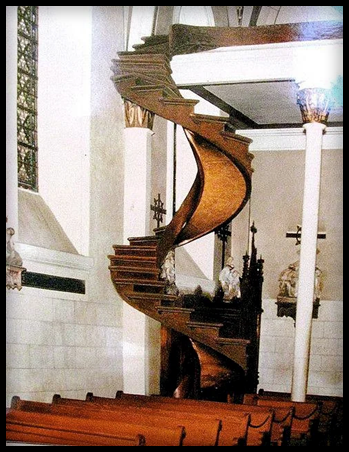
The origins trace back to a practical crisis. When the chapel was completed, the sisters faced an awkward architectural problem. The choir loft sat 22 feet above the nave, accessible only by ladder. A conventional staircase would have devoured precious floor space in the modest sanctuary. After much deliberation, the nuns turned to prayer, specifically invoking St. Joseph, the husband of Mary and the foster father of Jesus, carpenter and patron saint of builders. According to the most enduring account, their novena concluded on the ninth day when a mysterious man appeared at the door. He claimed he could solve their problem with only a few simple tools and a donkey.
The sisters agreed, and over several months the stranger worked in seclusion, refusing to reveal his methods or accept payment in advance. When the staircase was finished—an elegant double-helix spiral of 33 steps—he vanished without collecting his wages or even giving his name. Some versions add that the sisters later discovered the wood was not native to the region and that no one in Santa Fe had seen such craftsmanship before.
What makes the staircase miraculous in the eyes of believers is not merely its beauty but its apparent defiance of structural logic. The staircase rises in two complete 360-degree turns, supported only by its outer stringer and an inner handrail that was added years later. Early observers noted the absence of a central pole or any visible fasteners holding the treads. The wood, long identified as a type of spruce not found locally, was joined with wooden pegs. The number of steps—33—matches the traditional age of Jesus at his crucifixion, a detail that feels too tidy to be a coincidence for those inclined toward symbolism.
The Record and the Legend
The Sisters of Loretto documented the event in their annals, and word spread quickly through the Catholic community of the Southwest. By the early 20th century, the staircase had become a minor pilgrimage site, its reputation amplified by guidebooks and oral tradition. Yet the legend’s power lies as much in what remains unexplained as in what is recorded.
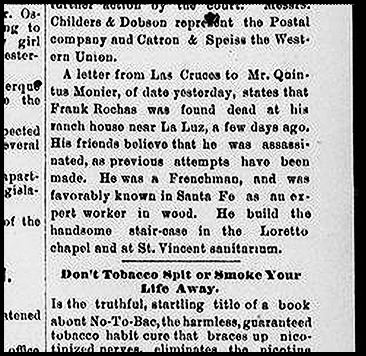
No one has ever conclusively proven the stranger’s identity. One popular theory points to a French-born carpenter named François-Jean “Frenchy” Rochas, (1843-1894) who lived in the area and was known for intricate woodwork. Rochas died in 1894, and some historical records suggest he may have been in Santa Fe during the relevant years. Proponents of this view argue that a skilled craftsman could have built the staircase using tension and compression principles familiar to European staircase makers of the era.
The helical form distributes weight outward to the walls, much like a coiled spring. Modern engineers who have studied the structure note that the wood’s natural flexibility and the precise joinery create a self-supporting system. In 1996, a team of architects and structural engineers examined the staircase and concluded it could stand without a central pole, though they acknowledged the design was unusually daring for its time and materials.
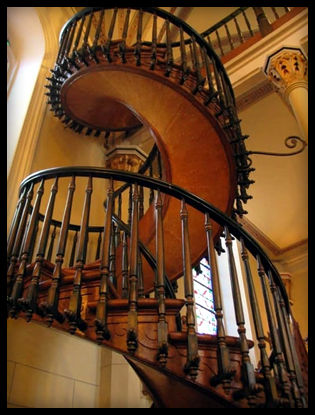
Still, questions persist.
Why did the carpenter refuse payment and disappear? How did he source wood that some early analyses claimed was not indigenous? Later examinations have revised that claim, suggesting the timber could have come from the mountains near Santa Fe or been imported via the Santa Fe Trail. The railing, added in 1887 by another craftsman, Philip August Hesch, (1832-1914) introduced metal balusters that altered the original appearance and perhaps masked earlier modifications. These adjustments complicate any attempt to reconstruct the exact original engineering. Skeptics point out that oral histories often grow more dramatic with retelling; the “miracle” may have begun as a simple act of charity by an itinerant worker whose skill outstripped local expectations.
An Enduring Enigma
The tension between faith and explanation keeps the staircase compelling. For the devout, the structure remains a sign that prayer can summon solutions beyond human calculation. The 33 steps, the vanishing builder, and the unsupported spiral function as a three-part sermon on providence. Visitors often climb the stairs slowly, pausing to feel the subtle give of the wood underfoot, as if testing whether physics alone could produce such grace. Others come armed with tape measures and curiosity, determined to reduce the mystery to geometry. Both groups leave changed, if for different reasons.

In a broader sense, the Loretto staircase mirrors countless historical enigmas where documentation is thin and wonder fills the gaps. Consider the Antikythera mechanism (see right graphic; as the first computer) or the construction of the Great Pyramid: artifacts that prompt us to ask whether we have underestimated our ancestors or whether some knowledge truly arrived from elsewhere.
The staircase occupies a similar middle ground. It is neither impossible nor ordinary. Its continued existence—now protected behind glass at the former chapel, which operates today as a museum and wedding venue—reminds us that human ingenuity and spiritual longing often travel the same spiral.
What endures is not a single definitive answer but the invitation to keep asking. Did a saint answer the sisters’ prayers through an anonymous craftsman, or did an anonymous craftsman simply answer their practical need with extraordinary talent? Perhaps the real miracle lies in the fact that both interpretations remain available after more than a century.
In a world quick to demand proof or dismiss the unexplained, Loretto Chapel preserves a space where doubt and devotion can share the same narrow steps. Visitors who ascend them still feel, for a moment, suspended between earth and something higher—exactly as the sisters must have felt when they first saw their impossible staircase completed.

This article was generated (mostly) by the Grok 4 A.I. Model https://x.ai/grok

EBOOK RETAILERS
ISBN Kindle: 9780992009816 (ASIN: B00DAKRR2Q)
>>> GRAIN -Mystical Poems <<<
PAPERBACK RETAILERS
ISBN: 9781489503596
Amazon
Books A Million
Alibris
Abe Books
Bookshop
Take a Look Inside!

New Edition!
Mystical Poems of love, life, death, hope and victory!
“GRAIN by Doug Bentley is an erudite, insightful, and provocative poetic journey through the mystical regions of the human psyche. From first word to last, this thought-provoking volume of sonnets and free verse begs to be pondered – to be mulled over and savored like a fine wine.”
– Rich Follett for Readers’ Favorite
Check out this book here!