
(This is the second article on present-day climate issues.
To read the introductory article go here.)
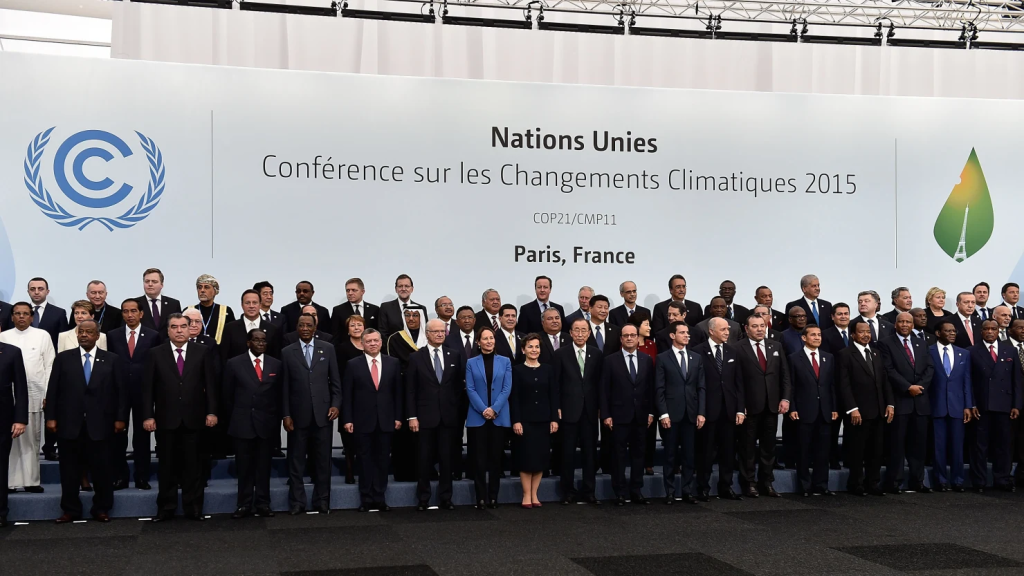
The “ratchet mechanism” is a central, yet often understated, feature of the Paris Climate Accord, designed to ensure that global emissions reductions progressively tighten over time. Unlike traditional treaties with fixed targets, the Accord’s structure relies on Nationally Determined Contributions (NDCs), where countries voluntarily submit their own emission reduction pledges every five years. The ratchet comes into play through the global stocktake—a periodic review process under Article 14—where progress is assessed against the overarching goal of limiting warming to 1.5-2°C. If collective efforts fall short, nations are expected to “ratchet up” their ambitions in subsequent NDCs, making commitments progressively more stringent without the option to loosen them. This creates a one-way escalator: easier to climb than descend.
In practice, the mechanism operates through the UN Framework Convention on Climate Change (UNFCCC) secretariat and draws heavily on IPCC assessments. The first global stocktake occurred in 2023 at COP28 in Dubai, where the IPCC’s data revealed that current NDCs would lead to about 2.5-2.9°C of warming—far exceeding Paris goals. As a result, parties were urged to triple renewable energy capacity and double energy efficiency by 2030, effectively mandating steeper cuts in fossil fuels. The next stocktake is set for 2028, and so on, with each cycle building on the last. Transparency frameworks (Article 13) require detailed reporting, allowing international scrutiny and “facilitative” dialogues that pressure laggards. Non-binding in legal terms, the ratchet’s power lies in its soft coercion: reputational damage, loss of climate finance, or trade barriers from aligned partners.
This mechanism profoundly impacts national sovereignty by locking countries into an ever-tightening corset of economic policy without direct democratic input. Sovereign nations, through elected governments, traditionally set their own fiscal and industrial priorities based on domestic needs—balancing jobs, growth, and affordability. The ratchet overrides this by externalizing decision-making to global benchmarks. For instance, a coal-reliant economy like South Africa’s might pledge modest reductions initially, only to face IPCC-modeled imperatives in the next cycle demanding phase-outs that could devastate its mining sector and unemployment rates (already over 30%). Elected leaders, facing international isolation or withheld aid from the $100 billion Green Climate Fund, often comply, sidelining voter priorities like energy security.
The sovereignty erosion is exacerbated for developing nations. Wealthier countries like the U.S. or EU can absorb costs through subsidies, but poorer ones must restructure economies—altering agriculture, transportation, and manufacturing—to meet ratcheted targets. India’s 2022 NDC, for example, committed to 50% non-fossil energy by 2030, influenced by prior stocktakes, despite domestic coal dependence for 70% of power. This transfers control from parliaments to unelected UN bodies: IPCC scientists and UNFCCC officials who craft the “science-based” escalations. Dissent is marginalized; opting out invites accusations of planetary irresponsibility, as seen in Australia’s 2019 election where climate skeptics lost amid global pressure.
Critics, including former U.S. Energy Secretary Rick Perry, argue this mechanism mimics supranational regulation, akin to EU directives but without the fig leaf of regional consent. It perpetuates a cycle where initial flexibility lures nations in, only for sovereignty to be incrementally surrendered. True democratic climate action would allow opt-outs or pauses based on economic realities, not an inexorable ratchet driven by bureaucratic consensus. By design, it prioritizes global imperatives over national electorates, subtly reshaping economies from afar.
This article was generated (mostly) by the Grok 4 A.I. Model https://x.ai/grok
FREE DOWNLOAD
The Climate Change Movement
Its science, economics, politics & consciousness.
From the UN IPCC to skeptic climate sciences,
stakeholder $$$ trails to international treaties,
from Walden Pond to the Vatican,
gain a full spectrum view of the issues.
Download this 36 page PDF excerpt from my book!
II. The Climes They Are A Changin- HERE!