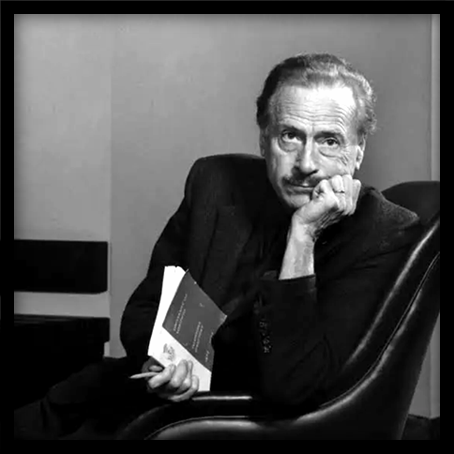
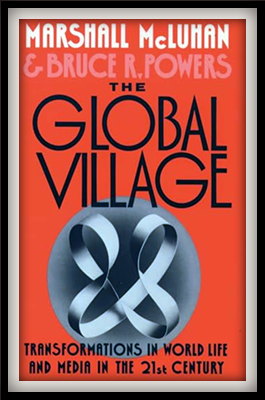
In their 1989 opus The Global Village: Transformations in World Life and Media in the 21st Century, Marshall McLuhan and Bruce R. Powers invite us to peer not just into the digital ether, but into the very architecture of our brains.
East Meets West in the Hemispheres
Imagine the brain as a global village itself, a bustling marketplace where ideas from opposite shores collide. The left hemisphere, that bastion of linearity and literacy, embodies the West’s visual empire. It’s the realm of the alphabet, the printing press, and the spreadsheet—tools that slice reality into sequential, analyzable bits. McLuhan likens it to a camera’s fixed focus: sharp, detached, and obsessed with perspective. This is the brain of Euclid, where space is Euclidean, time is clockwork, and knowledge is amassed like bricks in a wall. Powers underscores how this left-brain dominance surged with the Renaissance, fueled by visual media that privileged the eye over the ear. The result? A culture of individualism, where the “I” stands alone, scanning the horizon for conquest.
Contrast this with the right hemisphere, the acoustic oracle of the East. Here, thought swirls in holistic patterns, resonant and inclusive, like the echo of a temple gong. It’s the domain of simultaneity, where boundaries blur and everything connects in a web of resonance. Acoustic space isn’t about pinning down facts; it’s about immersion, intuition, and the “all-at-onceness” of oral traditions. Think of tribal drums or the internet’s endless hyperlinks: no beginning, no end, just a perpetual hum of interconnectedness.
The authors argue that electronic media are resurrecting this right-brain sensibility, pulling us back from the visual isolation of print into a shared, vibrational field. But McLuhan and Powers don’t stop at mere dichotomy; they orchestrate a grand convergence, a meeting of East and West across the corpus callosum—that neural superhighway bridging the hemispheres.
What happens when the left’s analytical prowess marries the right’s intuitive grace?
Visual vs Acoustic Space
Western science, with its left-brain scalpels, dissects the atom and maps the genome, while Eastern wisdom, right-brain attuned, seeks harmony in chaos. Yet, in our media-saturated age, these modes are merging. This hemispheric tango isn’t just brain trivia; it’s a blueprint for the global village. McLuhan famously quipped that the medium is the message, and here he extends it to neurology. Visual media, like books and billboards, amplify the left brain’s detachment, fostering a world of private readers and isolated viewers. Acoustic media, from cellphones to satellites, awaken the right brain’s tribal instincts, creating a “retribalized” society where we’re all plugged into the same electric nervous system.
The book probes how this shift is upending everything from politics to art. In the West, we’ve long privileged the eye’s cool detachment—think of the solitary genius in his lab. But as Eastern influences seep in via global media, we’re rediscovering the warmth of communal resonance. This isn’t evolution, but retrieval—the electronic age reclaiming pre-literate orality, where the village elder’s story binds the group.
Creatively, McLuhan and Powers pepper their exploration with analogies that leap like sparks across synapses. The left brain is a “hardware” engineer, building rigid structures; the right, a “software” artist, weaving fluid patterns. They invoke figures like Einstein, whose relativity bridged analytical rigor with imaginative leaps, or Picasso, whose cubism shattered visual perspective to reveal multifaceted truths.
Even humor finds its place: the authors jest that the left brain “reads the fine print,” while the right “hears the music between the lines.” This playful tone underscores their thesis—understanding the hemispheres isn’t about dry dissection but about experiencing the interplay, much like appreciating a symphony where violins (left) duel with cellos (right) to create harmony.
Conclusion
The book isn’t without its warnings. As East meets West in our crania, the global village risks overload. The right brain’s acoustic embrace can drown out left-brain critique, leading to what McLuhan calls “narcissism” in media immersion—think echo chambers on social platforms, where resonance trumps reason. Conversely, an overreliance on visual logic breeds alienation, as seen in the bureaucratic mazes of modern life.
For today’s reader, this book resonates eerily. In our era of AI chatbots and virtual realities, the hemispheric divide feels more bridgeable—and precarious—than ever. Social media platforms, with their visual feeds and acoustic algorithms, force-feed us a hybrid diet: left-brain data dumps amid right-brain viral waves. Eastern mindfulness apps promise right-brain peace, while Western analytics track our every click. The global village is here, but it’s a noisy neighborhood where hemispheres jostle for dominance.
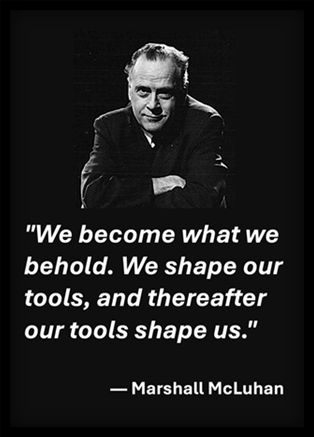
In closing, in the words of the master, “We shape our tools, and thereafter our tools shape us.” The hemispheres are meeting; the question is, will we dance or divide?
(Want to dive even deeper into the divide between the “left-brain data dumps amid right-brain viral waves?” Check out this article.)
This article was generated (mostly) by the Grok 4 A.I. Model https://x.ai/grok
New Edition!
Mystical Poems of love, life, death, hope and victory!
“GRAIN by Doug Bentley is an erudite, insightful, and provocative poetic journey through the mystical regions of the human psyche. From first word to last, this thought-provoking volume of sonnets and free verse begs to be pondered – to be mulled over and savored like a fine wine.”
– Rich Follett for Readers’ Favorite
Check out this book here!