A hundred years ago, in the 1920s, the Hooker Telescope at Mount Wilson Observatory in California stood as the world’s largest, with its 100-inch mirror revolutionizing our view of the cosmos. This era marked the birth of modern cosmology, challenging long-held beliefs.
Fast forward to today, and the James Webb Space Telescope (JWST), launched in 2021. The JWST is unveiling secrets of the early universe with unprecedented clarity. This $10 billion marvel, a collaboration between NASA, the European Space Agency, and the Canadian Space Agency, has already delivered groundbreaking discoveries that are reshaping our theories in stellar evolution, cosmology, and astronomy.
This article compares the cosmologies of these two periods.
Cosmology in the 1920s: A Static Universe on the Brink of Expansion
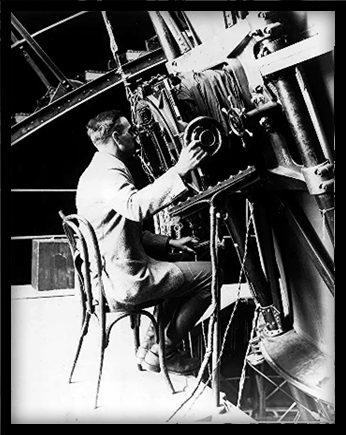
(Edwin Hubble seated at the 100-inch Hooker Telescope at the Mount Wilson Observatory in California.
Edwin P. Hubble Papers, Huntington Library, San Marino, California)
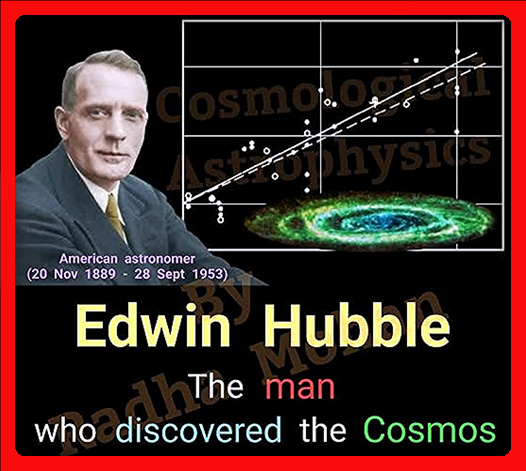
In the early 20th century, cosmology was in flux, transitioning from ancient notions to evidence-based science. The Hooker Telescope, completed in 1917, was a game-changer. Perched high on a mountain to minimize atmospheric distortion, it allowed astronomers like Edwin Hubble to peer deeper into space than ever before. By the mid-1920s, Hubble used it to demonstrate that “nebulae” were actually distant galaxies beyond our Milky Way, shattering the idea that our galaxy encompassed the entire universe. Hubble’s emerging evidence of galactic distances challenged literal interpretations of scriptures, sparking debates similar to those Galileo faced centuries earlier.
The prevailing astronomical theory was that the universe is static and eternal. Albert Einstein’s general theory of relativity, published in 1915, initially supported a finite, unchanging cosmos. To prevent gravitational collapse, Einstein added a “cosmological constant”—a repulsive force he later called his “biggest blunder.” Physics theories emphasized a steady-state model, where the universe had no beginning or end, aligning with Newtonian mechanics extended to cosmic scales. There was little room for concepts like an expanding universe.
Many interpreted the eternal cosmos as evidence of a divine, unchanging order. Christian theologians drew parallels to biblical creation, seeing the universe’s stability as proof of God’s eternal nature. In non-Western traditions, such as Hinduism’s cyclical time or Indigenous cosmologies, the static model resonated with ideas of eternal recurrence, blending science with spiritual beliefs.
Today’s Cosmology: The Big Bang and Beyond, Revealed by JWST
Contrast the Hooker Telescope era with the cosmology illuminated by JWST, an infrared observatory orbiting 1.5 million kilometers from Earth. Unlike the Hooker Telescope’s visible-light focus, JWST detects heat signatures from the universe’s infancy, peering back 13.5 billion years. JWST’s ability to detect faint infrared light from the distant past challenges assumptions: early galaxies appear too mature, suggesting faster formation than predicted, possibly hinting at new physics like modified gravity or exotic particles. Its discoveries are forcing revisions to our cosmic theories.
In astronomy and physics, today’s standard model is the Lambda Cold Dark Matter (ΛCDM) framework, built on the Big Bang theory. According to that theory the universe began 13.8 billion years ago in a hot, dense explosion, and has been expanding ever since. Dark matter (invisible mass shaping galaxies) and dark energy (accelerating expansion)—elements unknown in the 1920s__ dominate, comprising 95% of the cosmos.
JWST’s deep-field images, like those from the SMACS 0723 cluster, have revealed thousands of previously unseen galaxies, some warped by gravitational lensing. These show that spiral galaxies formed earlier than expected, challenging hierarchical formation models. A landmark discovery came in 2022 with the identification of galaxies existing just 300-500 million years after the Big Bang—much earlier and more massive than theories allowed. Galaxy GN-z11, observed by JWST, showed a redshift indicating it formed when the universe was only about 400 million years old. Yet, it was already as massive as the Milky Way today, packed with billions of stars.
Another unpredicted discovery is the detection of early supermassive black holes. In 2023, JWST spotted a black hole in the galaxy CEERS 1019, with a mass equivalent to millions of suns, existing only 570 million years after the Big Bang. Traditional cosmology assumed black holes grew gradually from stellar remnants, but this find implies they might form directly from collapsing gas clouds or through exotic processes in the early universe. This is revolutionizing our view of cosmic dawn—the era when the first stars lit up the universe—suggesting it happened faster and more violently than thought.
These findings mean the universe’s “baby pictures” are sharper than ever, forcing us to rethink how quickly the cosmos matured from a formless soup to a structured web of galaxies. Traditional models, based on observations from ground-based telescopes and Hubble, suggested that stars form gradually from collapsing gas clouds, evolving through stages like protostars, main-sequence stars, and eventually supernovae or black holes. However, JWST’s infrared vision has uncovered details showing that star formation can be more rapid and complex than previously thought.
JWST’s observations of the cosmic microwave background’s afterglow, through projects like the COSMOS-Web survey, have hinted at inconsistencies in the universe’s expansion rate (i.e.the Hubble tension). By mapping distant galaxies with high precision, JWST is providing data that could resolve whether dark energy or modified gravity is at play.
In exoplanet research, JWST’s spectroscopy has analyzed atmospheres of distant worlds. In 2022, it detected carbon dioxide on WASP-39b, a hot Jupiter-like planet, confirming active atmospheric chemistry and hinting at potential habitability markers on other worlds. This revolutionizes astronomy by suggesting that life-friendly conditions might be more common than mathematical predictions allowed.
Looking Ahead: A New Era of Discovery
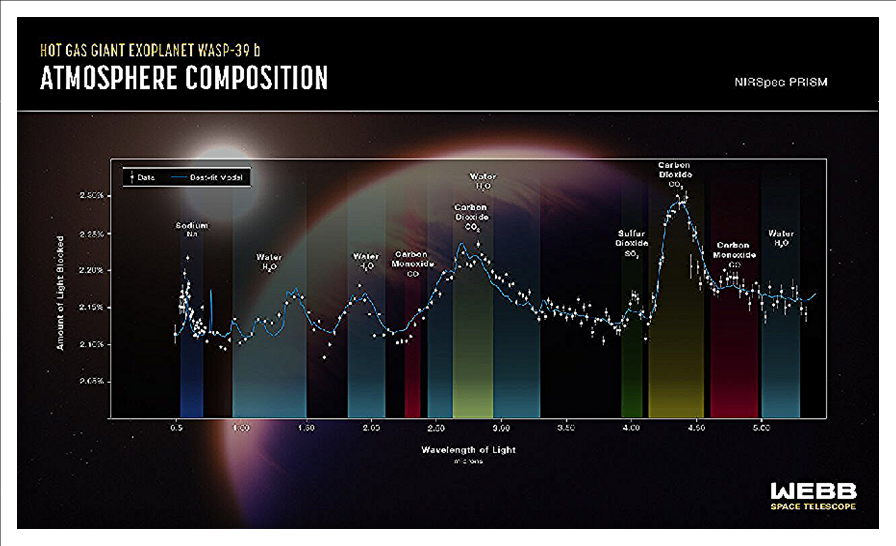
(The atmospheric composition of the hot gas giant exoplanet WASP-39 b has been revealed by the NASA/ESA/CSA James Webb Space Telescope.)
In just four years of operation, the James Webb Space Telescope has upended long-held theories, proving that the universe is more dynamic and surprising than we imagined. From revealing turbocharged star births in nebulae to uncovering massive galaxies in the infant universe, JWST’s findings support the hypothesis that our models need urgent refinement. By challenging our assumptions, JWST isn’t just observing the universe—it’s redefining how we understand it.
Scientific paradigm shifts also echo in art, culture, and religion. Artistically, contemporary works draw from JWST’s stunning images, like the psychedelic hues of the Pillars of Creation. In popular culture, films like Interstellar and Everything Everywhere All at Once explore multiverse theories. Inspired by quantum cosmology, the new paradigm reflects a universe of infinite possibilities rather than static certainty.
Today’s JWST cosmology promotes a “cosmic perspective.” It fosters global environmentalism—seeing Earth as a fragile “pale blue dot” in an expanding void encourages sustainability. It influences discussions on human unity, diminishing nationalist divides in favor of shared cosmic heritage.
Religiously, modern JWST cosmology has sparked diverse responses. Some see the Big Bang as aligning with creation narratives, like the biblical “Let there be light.” Others, in Eastern traditions, parallel expansion with Buddhist impermanence. JWST’s early universe revelations question timelines in Young-Earth Creationism. Atheistic views gain traction, portraying the cosmos as a self-sustaining system without need for divine intervention. Yet, many find spiritual depth in its mysteries.
Key Differences: From Static to Dynamic, Anthropocentric to Humble
Comparing the two eras highlights stark contrasts. The Hooker’s visible-light limitations meant cosmology relied on nearby observations; JWST’s infrared penetration reveals the distant, dust-shrouded past, integrating quantum mechanics and relativity in ways Einstein could scarcely imagine.
Culturally, the 1920s’ human-centered optimism contrasts with today’s humility, where cosmic vastness underscores our smallness. The static model supported eternal divine order; today’s expanding, fine-tuned universe invites debates on purpose versus chance, blending faith with science more fluidly.
The Hooker Telescope opened our eyes to a bigger universe; JWST is rewriting its history. These changes remind us that science doesn’t just describe reality—it reshapes how we see ourselves.
(Want to know more about the James Webb Space Telescope discoveries?
Check out this article.)
This article was generated (mostly) by the Grok 4 A.I. Model https://x.ai/grok

Amazon
Books A Million
Alibris
Abe Books
Bookshop
also available at Ingram Content Group, NACSCORP, Baker & Taylor
Get GO the Amazon Kindle Edition here!
Ladies and Gentlemen of the Theatre…. A Comedy of Absurdities!
Step through the looking glass with this revolutionary new play. GO takes your average night at the theatre and throws it out the window.
Filled with wit, slapstick, satire, insight and backbite, GO packs entertainment for all. Audiences will be charmed by the quirky characters who come and go throughout GO’s four imaginative acts. This mind-bending script inspires truly visionary direction, and rewards actors with an array of emotionally compelling roles. You can trust GO to deliver an unforgettable night at the theatre.