
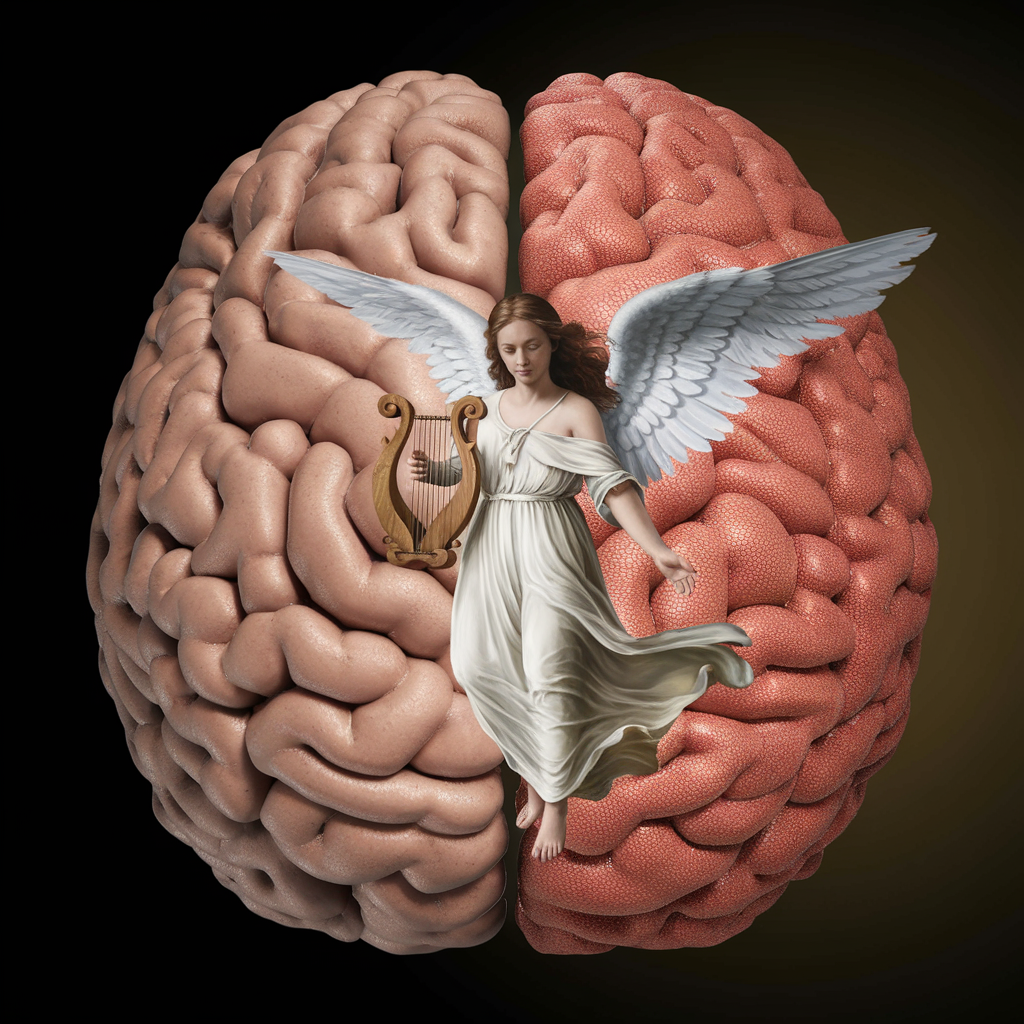
Before diving into this article, I’ll provide a brief analysis of the previous one, “The Corpus Callosum: Bridge of the Brain” That article explores the corpus callosum as the brain’s interhemispheric bridge, emphasizing its role in integrating the left and right hemispheres for unified cognition, emotion, and behavior. The article highlights a key human anomaly: despite our advanced brains, the corpus callosum is relatively undersized and prone to “noise” in signal transmission, leading to distortions that affect perception, contribute to psychological disorders like schizophrenia, and even manifest in societal issues such as political polarization, misinformation, and cultural fragmentation.
The article draws intriguing comparisons to other mammals and frames this “noise” as an evolutionary or inherent flaw, metaphorically akin to the biblical “original sin.” It speculates on broader implications, from cognitive dissonance to global conflicts, and hints at potential redemption through technology or medicine. This sets the stage for the following article, which builds on these ideas by speculating on solutions to minimize this noise.
Speculative Pathways to Quieting the Corpus Callosum
The human brain, that intricate symphony of neurons, harbors a profound imperfection at its core: the corpus callosum, a bundle of over 200 million nerve fibers linking the left and right hemispheres. This structure acts as a vital communication highway, yet in humans, it is paradoxically undersized relative to our expansive neocortex. This anatomical quirk introduces a high noise-to-signal ratio. Essentially, interference distorts the electrical impulses zipping between hemispheres. Signals can be amplified, muted, or warped by synaptic misfires, myelin degradation, or external stressors like cortisol. The result? Perceptual illusions, emotional mismatches, and behavioral quirks that ripple outward into societal fractures, political echo chambers, mental health epidemics.
But what if we could heal this “original flaw,” as some liken it to the biblical fall from grace? Minimizing or eliminating this noise isn’t mere science fiction; it’s a frontier where modern neuroscience, pharmaceuticals, and medical technologies converge. Let’s speculate on breakthroughs that could restore clarity to this neural bridge, drawing on real innovations while envisioning their transformative applications.
Pharmaceutical Pathways: Remyelination, Nootropics, and Psychedelic Resets
At the heart of the problem lies the corpus callosum’s myelinated axons—insulated cables that transmit signals at lightning-like speed. In humans, these are sparser than in animals like dolphins or elephants, whose robust callosums handle vast neural loads with less distortion. Noise arises from multiple sources: inefficient myelin sheaths that slow conduction, neurotransmitter imbalances that garble messages, and inflammation that erodes structural integrity. To heal this, we must target these vulnerabilities.
One promising avenue is pharmaceuticals designed to bolster myelin and reduce inflammation. Consider the rise of remyelinating drugs, inspired by treatments for multiple sclerosis (MS), where myelin erosion disrupts neural signaling. Clemastine, an over-the-counter antihistamine repurposed in clinical trials by researchers at the University of California, San Francisco, has shown potential to promote myelin repair. In a 2017 study published in The Lancet, participants with MS experienced improved nerve conduction after treatment. Adapting such drugs for non-pathological use could minimize corpus callosum noise.
Imagine a daily pill that thickens myelin layers, reducing signal leakage and distortion. Emerging nootropics like modafinil, already used for cognitive enhancement, hint at this; they sharpen focus by modulating dopamine and norepinephrine, potentially streamlining interhemispheric communication.
Psychedelics, too, offer intrigue. Psilocybin, the active compound in magic mushrooms, is undergoing FDA trials for depression via companies like Compass Pathways. Neuroimaging studies, such as those from Imperial College London, reveal that psilocybin increases brain connectivity, including across hemispheres, by promoting neuroplasticity. Could a controlled dose “reset” noisy pathways, fostering clearer signal transmission? For disorders like schizophrenia, where callosal distortions contribute to delusions, such therapies might recalibrate the brain’s switchboard, turning cacophony into harmony.
Neurotechnology Interventions: From TMS and DBS to Brain–Computer Interfaces
Beyond pills, medical technologies promise direct intervention. Transcranial magnetic stimulation (TMS), a non-invasive technique approved by the FDA for depression, uses magnetic pulses to modulate brain activity. Devices like those from Neuronetics deliver targeted stimulation to specific regions, potentially enhancing callosal efficiency. A 2022 study in Biological Psychiatry demonstrated that repetitive TMS improved interhemispheric connectivity in patients with autism spectrum disorders, where callosal underdevelopment is common. Customizing TMS protocols could “tune” the corpus callosum, filtering out noise like an audio equalizer. Imagine wearable TMS headsets, evolving from current clinical models, that users don during meditation or work, subtly amplifying clean signals while dampening interference.
Deeper still, deep brain stimulation (DBS) implants electrodes into the brain to deliver electrical pulses, already transformative for Parkinson’s disease. Companies like Medtronic have refined DBS to target precise neural circuits. In the context of the corpus callosum, future iterations could place electrodes along its midline, modulating axonal firing to reduce distortion. A speculative leap: combining DBS with AI algorithms, as in Neuralink’s brain-computer interfaces (BCIs), could revolutionize this.
Neuralink, founded by Elon Musk, implants flexible threads into the cortex to read and write neural data. Early trials in 2023 allowed paralyzed patients to control cursors with thoughts. Applied to the corpus callosum, such BCIs might act as “neural bridges,” bypassing noisy axons with digital relays. Algorithms could detect distortion in real-time—say, a muddled emotional signal from the right hemisphere—and correct it before it reaches the left, ensuring pristine transmission.
This isn’t far-fetched; research at Stanford University on optogenetics, which uses light-sensitive proteins to control neurons, has already achieved precise signal manipulation in mice. Human trials, backed by initiatives like the BRAIN Initiative, could extend this to callosal repair, illuminating noisy pathways to eliminate interference.
Genetic and Nanotech Futures: Engineering a Quieter Neural Bridge
Gene therapy represents another breakthrough horizon. CRISPR-Cas9, the Nobel-winning gene-editing tool, could target genes involved in myelin production, such as those mutated in leukodystrophies. In 2023, Vertex Pharmaceuticals and CRISPR Therapeutics gained approval for a sickle cell treatment, proving the tech’s viability. Editing genes to enhance callosal axon density or myelin resilience might “upgrade” the human brain evolutionarily.
Nanotechnology adds flair: nanobots, as prototyped in labs at MIT, could navigate the brain’s vasculature to repair damaged myelin sheaths, minimizing noise at the molecular level. Picture injectable swarms that seek out inflamed axons, delivering anti-inflammatory agents or reinforcing insulation, all guided by MRI feedback.
These innovations aren’t without risks—ethical quandaries about “enhancing” normal brains, potential side effects like over-stimulation, or accessibility divides loom large. Yet, the societal payoff could be immense. By quieting callosal noise, we might mitigate cognitive dissonance, fostering empathy in polarized societies. Political discourse could evolve from tribal shouting matches to nuanced dialogues, as clearer interhemispheric integration tempers biases. Mental health crises, from anxiety to schizophrenia, might abate, with reduced distortions preventing the amplification of fears into delusions. Even creativity could flourish, as undistorted signals blend analytical and intuitive thinking seamlessly.
In a broader sense, healing this neural flaw echoes the document’s biblical metaphor: a redemption from our “original sin” of miscommunication. Technologies like Neuralink or psilocybin-assisted therapy could bridge not just hemispheres but human divides, promoting a unified consciousness. As we speculate on these frontiers, remember that the brain’s plasticity is our greatest ally. With ongoing research the noisy bridge may soon hum with clarity, unlocking human potential we can scarcely imagine.
This article was generated (mostly) by the Grok 4 A.I. Model https://x.ai/grok

PAPERBACK RETAILERS
Amazon
Books A Million
Alibris
Abe Books
Bookshop
Ladies and Gentlemen of the Theatre…. A Comedy of Absurdities!
Step through the looking glass with this revolutionary new play. GO takes your average night at the theatre and throws it out the window.
Filled with wit, slapstick, satire, insight and backbite, GO packs entertainment for all. Audiences will be charmed by the quirky characters who come and go throughout GO’s four imaginative acts. This mind-bending script inspires truly visionary direction, and rewards actors with an array of emotionally compelling roles. You can trust GO to deliver an unforgettable night at the theatre.