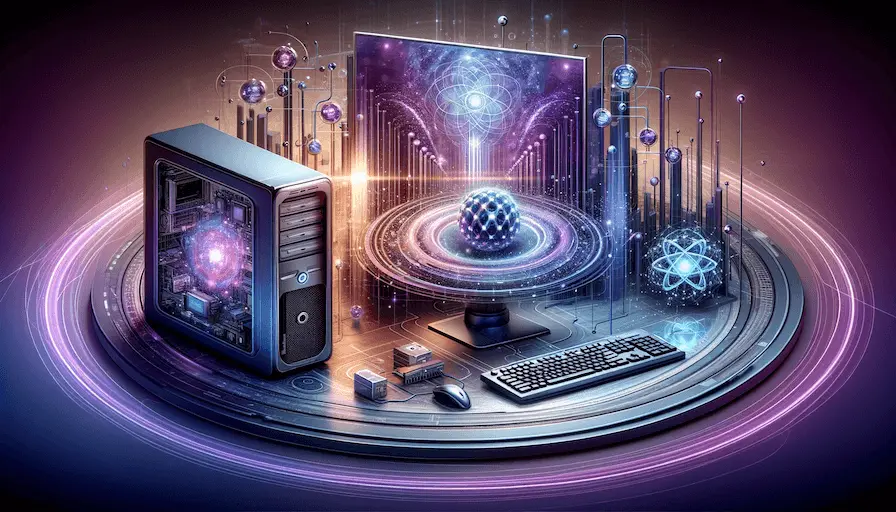
From 20 Million Years to 15 Minutes
In the realm of quantum computing, achieving a demonstrable quantum advantage—where a quantum system outperforms classical counterparts in a practical task—has long been a holy grail. Recent work from researchers at the Technical University of Denmark, published in the journal Science in December 2025, marks a pivotal milestone: the first proven quantum advantage using photonic systems. This breakthrough involves characterizing a noisy quantum system, a task that scales exponentially in complexity for classical computers, potentially requiring up to 20 million years of computation time. Remarkably, the team accomplished this in just 15 minutes using entangled light beams.
To appreciate this, let’s delve into the technical underpinnings. Quantum systems are notoriously difficult to characterize due to noise and decoherence, which introduce errors. In classical approaches, characterizing such a system typically involves repeated measurements to build a statistical model. The Danish team circumvented this by leveraging quantum entanglement in a photonic setup. They generated two entangled beams of light using standard optical components, such as beam splitters and nonlinear crystals.
One beam interacts with the noisy quantum system under study—probing its behavior—while the other serves as a reference. Upon recombination and joint measurement, the entanglement enables a form of noise cancellation. In this experiment, the entanglement extracts more information per measurement. Professor Ulrik Lund Andersen, the lead researcher, emphasized that this is the first photonic quantum advantage. This is something no classical system can replicate, not due to speed but fundamental capability. The approach hints at quantum-enhanced correlations in data that classical kernels cannot capture efficiently.
However, we must temper enthusiasm with realism. The 20 million years versus 15 minutes comparison assumes a specific classical algorithm and hardware; optimized classical methods might narrow the gap. Photonic systems are prone to photon loss, which degrades entanglement fidelity. As well, scaling this to larger systems will demand advances in integrated photonics. Nonetheless, the exponential scaling ensures quantum methods will dominate for sufficiently complex systems.
In summary, this photonic quantum advantage shifts the paradigm from brute-force computation to entanglement-enabled insight, paving the way for quantum technologies that redefine computational boundaries. As we explore further, the fusion of such techniques with emerging quantum hardware promises to unlock problems intractable to classical means.
(Listen to what the 2026 ANNUAL THREAT ASSESSMENT OF THE U.S. INTELLIGENCE COMMUNITY has to say about the security challenges of quantum computer research. )
This article was generated (mostly) by the Grok 4 A.I. Model https://x.ai/grok
New Edition!
Mystical Poems of love, life, death, hope and victory!
“GRAIN by Doug Bentley is an erudite, insightful, and provocative poetic journey through the mystical regions of the human psyche. From first word to last, this thought-provoking volume of sonnets and free verse begs to be pondered – to be mulled over and savored like a fine wine.”
– Rich Follett for Readers’ Favorite
Check out this book here!

