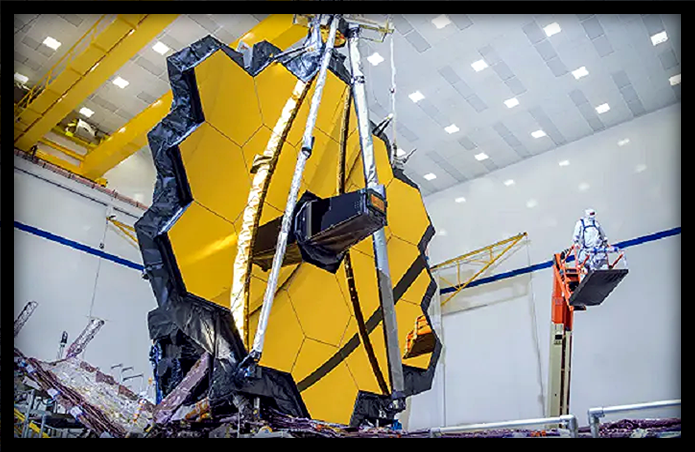
Imagine holding a mirror up to the universe’s infancy, a gleaming eye that pierces through the velvet curtain of space-time. That’s the James Webb Space Telescope (JWST), launched in 2021 and humming to life in 2022, like a cosmic storyteller awakening from a long slumber. Suspended 1.5 million kilometers from Earth, this golden marvel doesn’t just snap photos; it captures the faint echoes of light that have traveled billions of years to reach us.
For those of us more at home with brushstrokes and sonnets than equations, JWST feels like a poet’s lens, revealing the universe’s raw, untamed beauty—and its deepest mysteries. These aren’t dry facts etched in lab notebooks; they’re visual wonders that make you feel the chill of ancient starlight on your skin, the thrill of secrets unraveling like threads in a grand tapestry.
Since its first images flickered across our screens, Webb has unveiled discoveries that baffle the sharpest minds, upending what we thought we knew about physics and the cosmos. Let’s dive into three major revelations that have left scientists scratching their heads and redefined our place in the starry expanse.
1. Impossible Early Galaxies
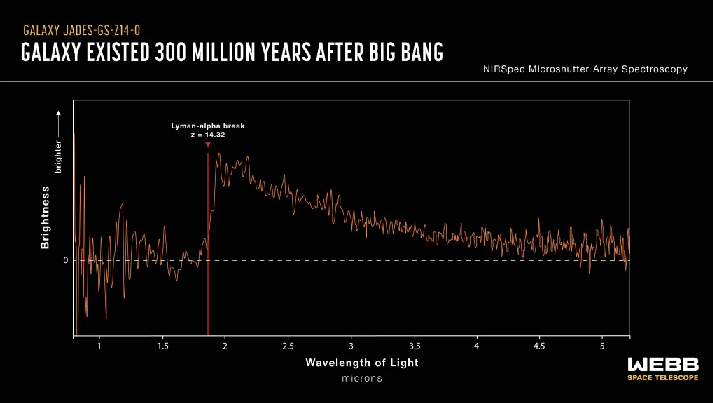
(Scientists used NASA’s James Webb Space Telescope’s NIRSpec (Near-Infrared Spectrograph) to obtain a spectrum of the distant galaxy JADES-GS-z14-0 in order to accurately measure its redshift and therefore determine its age. The redshift can be determined from the location of a critical wavelength known as Lyman-alpha break. This galaxy dates back to less than 300 million years after the big bang.
Credit: NASA, ESA, CSA, Joseph Olmsted (STScI). Science: S. Carniani (Scuola Normale Superiore), JADES Collaboration.)
First, picture the universe as a newborn, swaddled in the afterglow of the Big Bang, just a few hundred million years old. Conventional wisdom painted this era as a chaotic nursery, where galaxies were supposed to be fumbling infants—small, sparse clusters of stars slowly coalescing from cosmic dust. But JWST, with its infrared gaze slicing through the haze like a warm knife through fog, spotted something utterly confounding: massive, fully formed galaxies gleaming with the maturity of ancient oaks.
Take the galaxy dubbed JADES-GS-z14-0, spied in late 2022 as part of the JWST Advanced Deep Extragalactic Survey (JADES). This behemoth, existing less than 300 million years after the Big Bang, shines with the light of billions of stars, its structure as intricate as a Renaissance fresco. Scientists expected galaxies to build slowly, like clay pots shaped on a wheel over eons. Instead, these “impossible early galaxies” suggest a frantic rush, perhaps fueled by unknown forces that accelerated star formation.
It’s as if the universe hit fast-forward, birthing cosmic metropolises overnight. This discovery has revolutionized astrophysics, forcing a rethink of galaxy evolution models. Webb has made the early universe feel urgently present, a reminder that time isn’t the linear river artists often romanticize, but a swirling eddy full of surprises.
2. Unexpected Cocktails of Gases
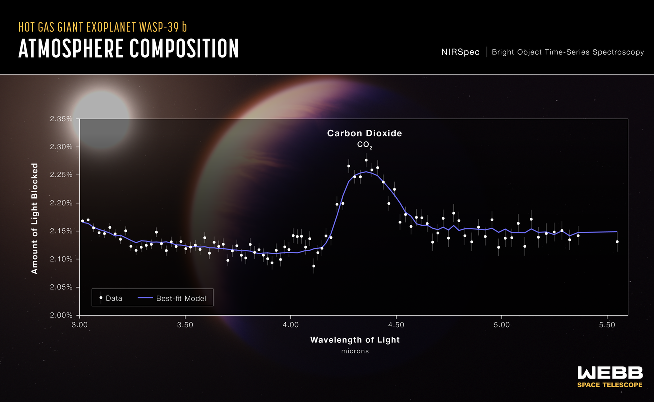
(A transmission spectrum of the hot gas giant exoplanet WASP-39 b captured by Webb’s Near-Infrared Spectrograph (NIRSpec) July 10, 2022, reveals the first clear evidence for carbon dioxide in a planet outside the solar system. This is also the first detailed exoplanet transmission spectrum ever captured that covers wavelengths between 3 and 5.5 microns.
Credit: Illustration: NASA, ESA, CSA, and L. Hustak (STScI); Science: The JWST Transiting Exoplanet Community Early Release Science Team)
JWST has also whispered secrets about the building blocks of life itself, tucked away in the frigid cradles of distant stars. In 2023, astronomers using Webb detected complex organic molecules—carbon-based compounds that are the Lego bricks of biology—in the icy clouds of a protoplanetary disk around a young star called IRS 48, over 200 light-years away.
These aren’t simple gases; they’re hefty hydrocarbons, including dimethyl sulfide (DMS), a molecule produced on Earth by marine plankton. This baffled researchers because such molecules were thought to form only in warmer, more evolved environments, not in these raw, sub-zero nurseries.
Then there’s the exoplanet K2-18 b, a “super-Earth” 120 light-years distant, where JWST sniffed out methane and carbon dioxide in its atmosphere, hinting at an ocean world shrouded in hydrogen. But the real jaw-dropper? Tentative signs of DMS, which on our planet signals biological activity. While not proof of alien life—far from it—this discovery revolutionizes our understanding of astrobiology, suggesting that life’s precursors might assemble far quicker and in harsher conditions than we imagined.
JWST has peeled back the veils of exoplanet atmospheres with unprecedented clarity. In 2022, it analyzed the hot Jupiter WASP-39 b, a gas giant 700 light-years away, detecting carbon dioxide in its hazy envelope for the first time. But the revolution came in 2023 with deeper dives: sulfur dioxide, born from photochemical reactions in the planet’s upper layers, painting a picture of dynamic, volcano-like chemistry without actual volcanoes. Imagine the sizzle of alien rain, acidic droplets hissing against scorching winds.
These findings have shaken planetary physics, showing that exoplanets defy our Earth-centric rules, with atmospheres that brew unexpected cocktails of gases. Each planet, a canvas of swirling chaos, reminds us that the universe’s palette is infinite and often wildly unpredictable.
3. Birth of a Dark Night
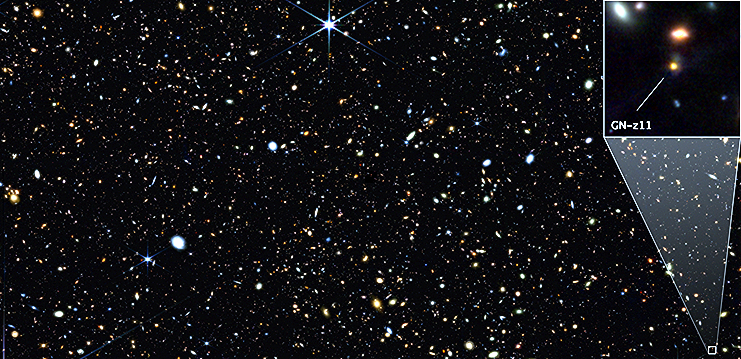
(This image from NASA’s James Webb Space Telescope NIRCam (Near-Infrared Camera) instrument shows a portion of the GOODS-North field of galaxies. At lower right, a pullout highlights the galaxy GN-z11, which is seen at a time just 430 million years after the big bang. The image reveals an extended component, tracing the GN-z11 host galaxy, and a central compact source whose colors are consistent with those of an accretion disk surrounding a black hole.)
Finally, JWST has illuminated the shadowy hearts of the cosmos, where supermassive black holes lurk. In 2023, it uncovered GN-z11, a galaxy 13.4 billion light-years away, harboring a black hole that’s astonishingly massive for its age—about a million times the sun’s mass, formed just 400 million years after the Big Bang. Traditional theories suggested black holes grow slowly, gobbling gas over billions of years like patient predators. But this one?
It’s as if it sprang fully armored from the void, perhaps seeded by direct collapse of massive gas clouds or exotic physics we don’t yet grasp. The discovery, part of the Cosmic Evolution Early Release Science (CEERS) survey, has physicists rethinking black hole formation, potentially invoking quantum weirdness or dark matter’s invisible hand.
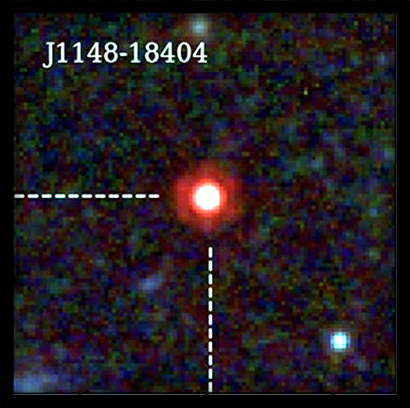
Then there are the intriguing Little Red Dot (LRD) galaxies. LRDs are high-redshift, infrared-bright galaxies discovered by the JWST in the early universe. Young, rapidly growing supermassive black holes, they lie hidden in dense, dusty, ionized gas. These objects (see example J1148-18404) exist approximately 600 million to 1 billion years after the Big Bang. They are considered to be an early, “hidden” phase of black hole evolution. LRDs are very compact, often with diameters of a mere 10 million km. They suggest that in the early universe, black holes grew much faster than their host galaxies, appearing “overmassive” compared to local universe relationships.
Summary
As JWST continues its vigilant watch, these discoveries weave a narrative that’s equal parts awe and humility. They’ve baffled scientists by exposing gaps in our understanding—galaxies too old too soon, molecules whispering of life in unlikely places, atmospheres defying prediction, black holes that cheat time. Yet for us, they evoke something deeper: a universe that’s alive, textured, and infinitely creative, much like a symphony or a sculpture in progress.
Webb isn’t just revolutionizing physics; it’s inviting us to feel the cosmos, to let its wonders seep into our stories and dreams. In a world often divided by the tangible and the abstract, these revelations bridge the gap, reminding us that science and art are twin flames illuminating the same eternal night.
Who knows what other secrets await in the next infrared glow? The stars, it seems, are just beginning to speak.
This article was generated (mostly) by the Grok 4 A.I. Model https://x.ai/grok

Mystic Antarctica is available only at the Amazon Kindle Store.
Mystic Antarctica at Amazon Kindle Stores here!
An Incredible Book of Maps of Antarctica!
Are you fascinated by the mysterious, remote, and awe-inspiring continent of Antarctica? This vast region, which holds a special place in our imaginations, is now available to explore like never before. Sourced from the new Raised Elevation Model of Antarctica (REMA), Mystic Antarctica brings you 75 of the highest resolution topographic maps of Antarctica ever created.
Whether you’re a scientist, explorer, student or simply fascinated with one of the last truly wild places on the planet, this unique collection of maps provides a glimpse into the untamed, untouched world beneath the Antarctic ice as it has never been seen before.
Treat yourself to this one-of-a-kind glimpse of Antarctica in all its majestic detail and mystique. And, if you’re searching for a unique, thoughtful gift for the adventurer, geographer, or map lover in your life, look no further than Mystic Antarctica.
Mystic Antarctica at Amazon Kindle Stores here!