
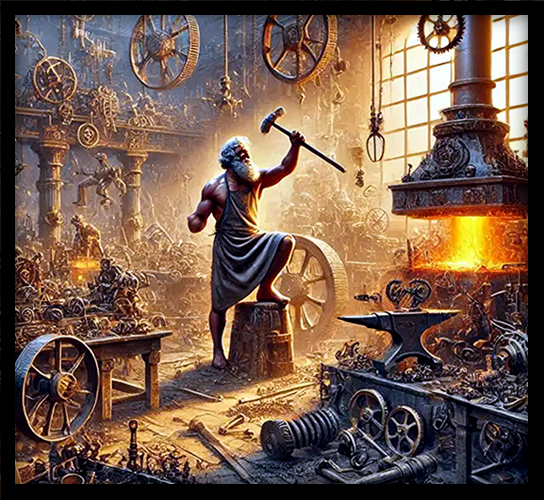
(In Greek mythology, Hephaestus is the god of fire. Ancient Greek writers used his name as a synonym for fire. Hephaestus is also a god of technology, including blacksmithing and all other forms of metalworking, as well as stonemasonry and crafts. In this image, Hephaestus is activating a robot. The Iliad is nearly three-thousand years old, and Hephaestus has robots in the Iliad!)
From Ancient Dreams to Modern Reality
The ambition to create intelligent machines is not a product of the digital age. It is an idea woven into the fabric of human civilization itself. From the mythological automata of ancient Greece — Hephaestus forging golden handmaidens endowed with reason — to the medieval legends of alchemical beings, humanity has long dreamed of breathing intelligence into the inanimate. But it was only in the twentieth century that this dream began its slow, uneven, and ultimately revolutionary march toward reality. The history of artificial intelligence is a story of audacious vision, bitter disappointment, and breakthroughs that have reshaped the world.
The Intellectual Foundations (1930s–1950s)
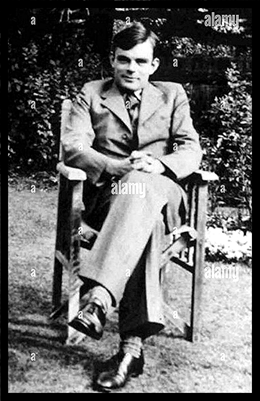
The theoretical groundwork for AI was laid well before the first computer hummed to life. In 1936, British mathematician Alan Turing (photo right) published his landmark paper, “On Computable Numbers,” in which he described a hypothetical device — now known as the Turing machine — capable of performing any computation that could be described algorithmically. This was more than a mathematical abstraction; it was the conceptual blueprint for the modern computer and, by extension, for the possibility of machine intelligence.
Turing returned to the question of thinking machines explicitly in 1950 with his paper “Computing Machinery and Intelligence,” in which he posed the deceptively simple question: Can machines think? Rather than attempt a philosophical answer, he proposed an operational test — the Turing Test — in which a human judge engages in a text-based conversation with both a machine and a human. If the judge cannot reliably distinguish between the two, the machine may be said to exhibit intelligent behavior. The test remains a touchstone in debates about AI to this day.
The Golden Years and the First Winter (1956–1974)
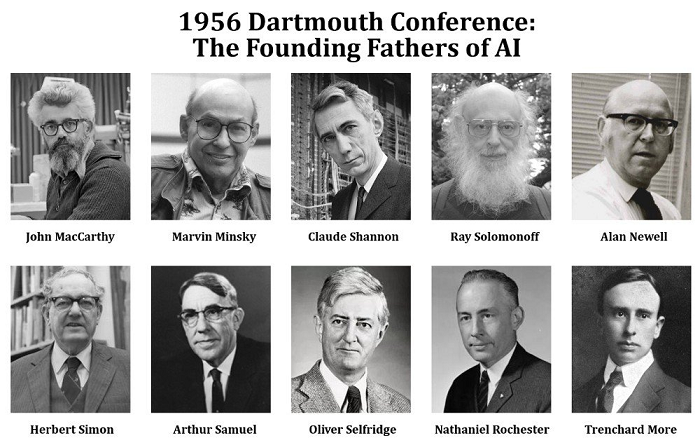
The formal birth of artificial intelligence as an academic discipline is typically dated to the summer of 1956, when a small group of researchers convened at Dartmouth College in Hanover, New Hampshire. Organized by John McCarthy, Marvin Minsky, Nathaniel Rochester, and Claude Shannon, the Dartmouth Workshop was predicated on a bold hypothesis: “Every aspect of learning or any other feature of intelligence can in principle be so precisely described that a machine can be made to simulate it.”
The workshop did not produce any immediate breakthroughs, but it gave the field its name — McCarthy coined the term “artificial intelligence” — and it brought together the minds that would dominate AI research for the next two decades. The optimism was electric. Herbert Simon, one of the early pioneers, predicted in 1957 that within ten years, a computer would be chess champion of the world and would discover and prove important new mathematical theorems. He was right about the theorems; the chess prediction would take forty years to fulfill.
The years following Dartmouth saw rapid, if narrow, progress. Programs like the Logic Theorist (1956) and the General Problem Solver (1957), developed by Allen Newell and Herbert Simon, demonstrated that machines could perform tasks previously thought to require human reasoning. Joseph Weizenbaum’s ELIZA (1966), a simple natural language processing program that simulated a psychotherapist, captivated the public, despite its creator’s insistence that it understood nothing at all.
Government funding, particularly from the U.S. Department of Defense through DARPA, fueled the field. Yet the ambitions of early AI researchers far outpaced the capabilities of the hardware and algorithms available to them. Problems that seemed tractable in simplified environments — like solving puzzles or translating languages — proved enormously difficult in the messy complexity of the real world. Machine translation, in particular, was a conspicuous failure: a 1966 government report concluded that the field had made little meaningful progress after a decade of investment.
By the early 1970s, disillusionment set in. The British Lighthill Report of 1973 delivered a withering assessment of AI research, concluding that the field had failed to deliver on its grand promises. Funding dried up. The period that followed, roughly 1974 to 1980, is known as the first “AI Winter” — a term that would become grimly familiar to researchers in the decades ahead.
Expert Systems and the Second Winter (1980–1993)
AI experienced a revival in the 1980s through the rise of expert systems — programs designed to emulate the decision-making abilities of human specialists in narrow domains. Systems like MYCIN, which diagnosed bacterial infections, and XCON (also known as R1), which configured computer orders for Digital Equipment Corporation, demonstrated genuine commercial value. By 1985, the AI industry was generating over a billion dollars a year.
But expert systems had critical limitations. They were brittle, expensive to maintain, and incapable of learning from new data. They required painstaking, manual encoding of human knowledge in the form of “if-then” rules — a process that scaled poorly. When the specialized hardware market collapsed in the late 1980s and the limitations of expert systems became undeniable, a second AI Winter descended, lasting roughly from 1987 to the mid-1990s.
The Quiet Revolution: Machine Learning Ascends (1990s–2010s)
While public enthusiasm cooled, a quieter revolution was underway. Researchers increasingly shifted their focus from hand-coded rules to machine learning — systems that could improve their performance by learning from data rather than following explicit instructions. This represented a philosophical shift as much as a technical one: instead of trying to program intelligence directly, researchers began creating the conditions under which intelligence could emerge.
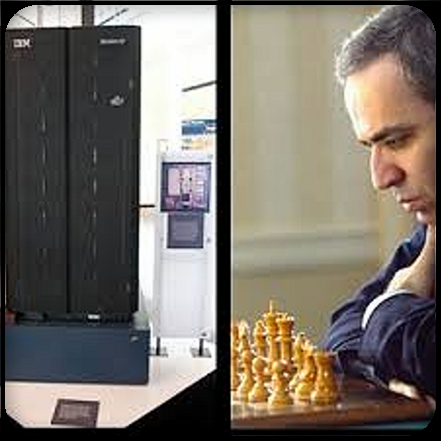
A pivotal moment came in 1997, when IBM’s Deep Blue defeated world chess champion Garry Kasparov in a six-game match (photo right). Though Deep Blue relied heavily on brute-force computation rather than general intelligence, the event was a cultural milestone that reignited public interest in AI. Through the 2000s, machine learning techniques began quietly transforming industries. Spam filters, recommendation engines, voice recognition systems, and search algorithms all benefited from these advances. AI was becoming ubiquitous, even if most people didn’t recognize it as such.
The decisive breakthrough came with the resurgence of deep learning, a class of machine learning based on artificial neural networks with many layers. In 2012, a deep neural network called AlexNet, developed by Alex Krizhevsky, Ilya Sutskever, and Geoffrey Hinton, won the ImageNet image recognition competition by a dramatic margin, slashing the error rate nearly in half compared to previous methods. This result electrified the field and triggered an explosion of research and investment in deep learning that continues to the present day.
The Modern Era: Generative AI and Large Language Models (2016–Present)
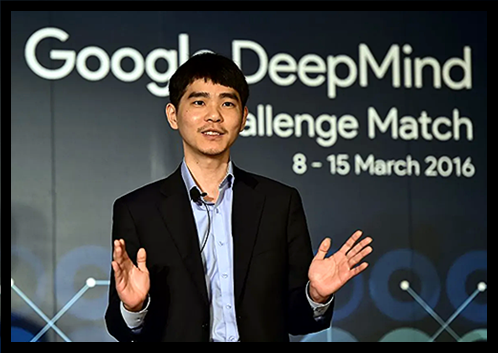
The pace of progress since 2012 has been staggering. In 2016, Google DeepMind’s AlphaGo defeated world Go champion Lee Sedol (photo right)— a feat widely considered to be at least a decade away, given the game’s astronomical complexity. Its successor, AlphaZero, taught itself to play chess, Go, and shogi at superhuman levels with no human knowledge beyond the rules of each game.
The emergence of large language models (LLMs) marked another inflection point. The publication of the Transformer architecture by Google researchers in the 2017 paper “Attention Is All You Need” provided the foundation for a new generation of AI systems. OpenAI’s GPT series, Google’s Gemini, Anthropic’s Claude, and Meta’s LLaMA demonstrated that scaling neural networks to vast sizes, trained on enormous corpora of text, could produce systems capable of remarkably fluent and contextually aware language generation.
The release of ChatGPT in late 2022 brought generative AI into the mainstream with unprecedented speed, reaching 100 million users within two months. Suddenly, AI was not a laboratory curiosity or an industrial tool hidden behind the scenes — it was a daily companion for millions.
Speculations on the Future
The trajectory of AI raises questions that are as much philosophical as they are technical. Researchers remain divided on the path to Artificial General Intelligence (AGI) — a hypothetical system with the ability to understand, learn, and apply knowledge across any domain at or above human level. Some, like those at OpenAI and DeepMind, have described AGI as an explicit goal. Others caution that current architectures, however impressive, may represent sophisticated pattern matching rather than genuine understanding.
The risks are debated with equal intensity. Concerns range from the immediate and concrete — job displacement, algorithmic bias, deepfakes, and the concentration of power in a small number of technology companies — to the existential. Figures like the late Stephen Hawking and AI researcher Stuart Russell have warned that a sufficiently advanced AI system, if improperly aligned with human values, could pose profound dangers. The field of AI alignment has emerged as one of the most urgent areas of research in response to these concerns.
On the optimistic side, AI holds transformative potential in medicine (drug discovery, diagnostics), climate science (materials research, energy optimization), education (personalized learning), and virtually every scientific discipline. The question is not whether AI will reshape civilization — it already is — but whether humanity can steer that transformation wisely.
Conclusion
The history of artificial intelligence is not a simple arc of progress. It is a story of cycles — of exuberance and disillusionment, of promises made and broken, and of breakthroughs that arrived not when predicted but when the confluence of theory, data, and computational power finally made them possible. From Turing’s 1950 thought experiment to the generative AI systems of today, the field has traveled an extraordinary distance. Where it goes next may well be the defining question of the twenty-first century.
(Take a peek into the future with this article on the Quantum Computer Internet.)
This article was generated (mostly) by the Grok 4 A.I. Model https://x.ai/grok

PAPERBACK RETAILERS
Amazon
Books A Million
Alibris
Abe Books
Bookshop
Life’s Sacred Questions? An Expansive Exploration
Philosophical Fragments Of Your Ancient Name takes you on a journey of self-discovery from the edges of our solar system to the sanctuary of your soul – and beyond! The book explores four dimensions of the human mind: scientific, social, theological and mystic.
This thought-provoking book pulls no punches in scrutinizing modern society. Environmental debates like climate change and our impact on the planet are dissected with nuanced arguments. Technology’s effects on our psychology and the growing inequality in our social systems are put under the microscope. The book boldly walks the line between rationalism and spiritual experience, challenging fixed views on both sides.