
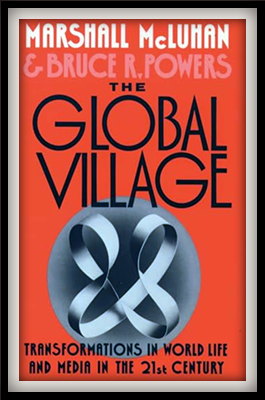
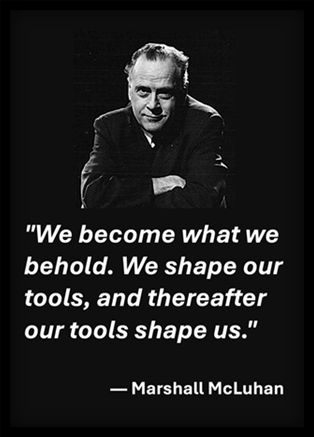
(This is the third article based on Marshall McLuhan & Bruce Powers 1989 book The Global Village: Transformations in World Life and Media in the 21st Century. Drawing on McLuhan’s iconic media theory, the book explores how technologies reshape human perception and society, with the “tetrad”—a four-part analytical framework—as a central tool. To read the previous article in this series, click here.)
The greatest discovery of the 21st Century will be the discovery that Man was not meant to live at the speed-of-light.
– Marshall McLuhan (1911 – 1980)
Understanding the Tetrad: McLuhan’s Probe into Technological Effects
In an era where robots assemble cars, perform surgeries, and even compose music, the rapid evolution of robotics technology feels both exhilarating and inevitable. Yet, as these machines infiltrate every corner of our lives, it’s worth pausing to ask: What deeper patterns emerge from this shift? Enter Marshall McLuhan and Bruce Powers’ 1989 book exploring the dynamics of tetrads.
The Global Village argues that technologies act as extensions of human senses and faculties, compressing the world into a metaphorical village where information flows instantaneously. At the heart of the book’s analysis is the tetrad, a deceptively simple yet powerful heuristic for dissecting any technology’s impact. By applying the tetrad to robotics, we can uncover not just the mechanics of innovation, but its profound cultural, economic, and existential ripples.
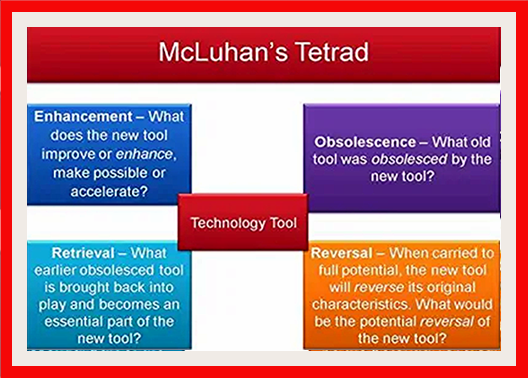
Inspired by the ancient Greek philosopher Empedocles’ four elements (earth, air, fire, water), the McLuhan Tetrad poses four interconnected questions to reveal a technology’s hidden dynamics:
- What does it enhance? This probes how the technology amplifies or intensifies existing human capabilities or societal patterns.
- What does it obsolesce? Here, we examine what older tools, habits, or structures the new technology renders redundant or pushes aside.
- What does it retrieve? This looks to the past, asking what archaic forms or sensibilities the technology revives from obsolescence.
- What does it reverse into? Finally, we consider the flip side: when pushed to its limits, what opposite or unintended effects does the technology produce?
The tetrad isn’t linear; it’s a simultaneous, probing mosaic that encourages holistic thinking. In The Global Village, McLuhan and Powers apply it to electronic media, predicting a world of instant connectivity that blurs boundaries between public and private, local and global. Today, as robotics emerges as a cornerstone of Industry 4.0, the McLuhan Tetrad offers a timeless framework to navigate its promises and perils.
Applying the Tetrad to Robotics Technologies
Robotics, encompassing everything from industrial arms to AI-driven humanoid companions, represents a convergence of mechanical engineering, artificial intelligence, and sensor networks. Let’s dissect it through the tetrad, revealing how this technology reshapes our world.
1. What Does Robotics Enhance?
Robotics supercharges human productivity and precision, extending our physical and cognitive reach in ways that echo McLuhan’s notion of technologies as “prostheses.” In manufacturing, robotic arms like those from Fanuc or ABB enhance assembly line efficiency, performing repetitive tasks 24/7 with sub-millimeter accuracy—far surpassing human limits. In healthcare, surgical robots such as the da Vinci system amplify surgeons’ dexterity, enabling minimally invasive procedures that reduce recovery times and errors.
Beyond the factory floor, robotics enhances collaboration in hazardous environments. Drones and underwater robots explore disaster zones (e.g. The Fukushima Nuclear Disaster Zone) or deep seas, gathering data that humans couldn’t access safely. Socially, companion robots like Japan’s Pepper enhance emotional support for the elderly, fostering connections in isolated societies. As McLuhan might say, robotics intensifies our “mechanical bride”—the marriage of human intent and machine execution—accelerating the global village’s pace of innovation and interdependence.
2. What Does Robotics Obsolesce?
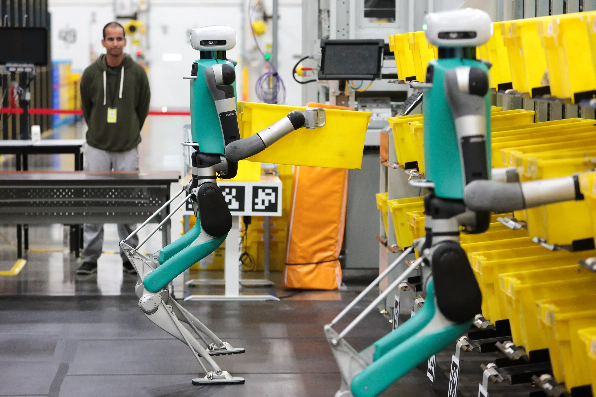
Every enhancement casts a shadow. Robotics obsolesces traditional manual labor and certain skill sets, disrupting economies built on human muscle and routine cognition. Blue-collar jobs in automotive assembly, once the backbone of the middle class, are fading; a 2023 Oxford Economics report estimates that up to 20 million manufacturing jobs could be automated by 2030. This isn’t limited to factories—self-driving vehicles from companies like Waymo threaten trucking and taxi professions, while AI-integrated robots in warehouses (e.g. Amazon’s fulfillment centers) sideline pickers and sorters.
On a subtler level, robotics obsolesces the artisan’s touch in crafts and services. Handmade goods and personalized interactions give way to standardized, algorithm-driven outputs, eroding the human element in production. In The Global Village, McLuhan warns of how media obsolesce sensory balances; similarly, robotics tips the scale toward efficiency over empathy, potentially fragmenting communities reliant on tactile, face-to-face work.
3. What Does Robotics Retrieve?
The tetrad’s backward glance reveals surprises: robotics retrieves pre-modern archetypes, pulling forgotten human patterns into the digital age. It revives the ancient dream of golems or automatons—mythical servants from folklore like the Jewish tale of the Golem or Hephaestus’s golden robots in Greek myth. In practice, this manifests in collaborative robots (cobots) that “retrieve” apprenticeship models, where machines learn alongside humans, echoing guild systems of old.
Robotics also retrieves a sense of play and exploration lost in industrialized rigidity. Educational robots like LEGO Mindstorms or Boston Dynamics’ Spot bring back the tinkerer’s workshop, democratizing invention much like the Renaissance inventor Leonardo da Vinci’s mechanical sketches.
Environmentally, robotic swarms for reforestation (e.g, planting drones in arid regions) retrieve indigenous stewardship practices, automating nature’s rhythms on a massive scale. As Powers and McLuhan describe in their book, such retrievals create a “mosaic” of past and future, where robotics bridges tribal instincts with technological sophistication.
4. What Does Robotics Reverse Into?
When overextended, robotics reverses into its opposite: from liberator to oppressor, enhancer to isolator. Pushed to extremes, it could spawn a surveillance state, where autonomous drones and facial-recognition bots enforce control, inverting empowerment into dystopian oversight—think China’s omnipresent robot patrols or predictive policing algorithms.
Economically, widespread adoption might reverse societal progress, widening inequality as job displacement outpaces reskilling, leading to a “robot underclass” of the unemployed. Psychologically, the intimacy of human-robot interaction could reverse into alienation. As robots handle caregiving or companionship, genuine human bonds might atrophy, fostering a village of virtual connections over real ones.
McLuhan and Powers caution in The Global Village that electronic extensions numb us to their effects; robotics, if unchecked, risks numbing our agency, turning creators into passive consumers of machine-made worlds.
Applications of the McLuhan Tetrad in the Robotics Industry
The tetrad isn’t just theoretical—it’s a practical tool for robotics innovators, policymakers, and ethicists. In R&D, companies like iRobot or SoftBank use tetrad-like analyses to anticipate market shifts: enhancing user interfaces while mitigating obsolescence through upskilling programs. For instance, Tesla’s Optimus project applies enhancement-retrieval dynamics to design humanoid robots that “learn” like apprentices, boosting adoption in service sectors.
In education and strategy, business schools incorporate the tetrad into curricula for robotics ethics courses, helping leaders probe reversals like bias in AI decision-making. Governments, too, apply it for regulation— the European Union’s AI Act, for example, implicitly addresses obsolescence by mandating human oversight in high-risk robotic systems. By framing robotics as a tetrad, the industry moves beyond siloed innovation toward balanced ecosystems, ensuring technologies serve the global village without unraveling its social fabric.
Consequences: Navigating the Global Village’s Robotics Horizon
The tetrad’s application to robotics underscores McLuhan and Powers’ prophetic vision: technologies don’t just change tools; they rewire existence. Positive consequences include unprecedented efficiency and equity—robots could eradicate drudgery, freeing humans for creative pursuits and addressing labor shortages in aging populations. Yet, the shadows loom large: economic dislocation, ethical dilemmas around autonomy (e.g. killer drones in warfare), and cultural homogenization as machine logic supplants diverse human narratives.
In the global village, these effects amplify through networks; a robotics breakthrough in one nation ripples worldwide, demanding international cooperation. Consequences extend to identity: as robots retrieve our mechanical myths, we must confront what it means to be human in a post-labor world. Failure to heed the tetrad risks reversal into fragmentation; embracing it promises a harmonious evolution.
McLuhan’s Tetrad reminds us that robotics isn’t destiny—it’s a probe. By enhancing thoughtfully, obsolescing mindfully, retrieving wisely, and reversing proactively, the industry can forge a future where machines extend, rather than eclipse, our humanity. As we stand on the cusp of this transformation, The Global Village urges vigilance: the village is shrinking, but its soul remains ours to shape.
(Want to learn more about McLuhan’s theories on future robotics and automations? Check out this article.)
This article was generated (mostly) by the Grok 4 A.I. Model https://x.ai/grok
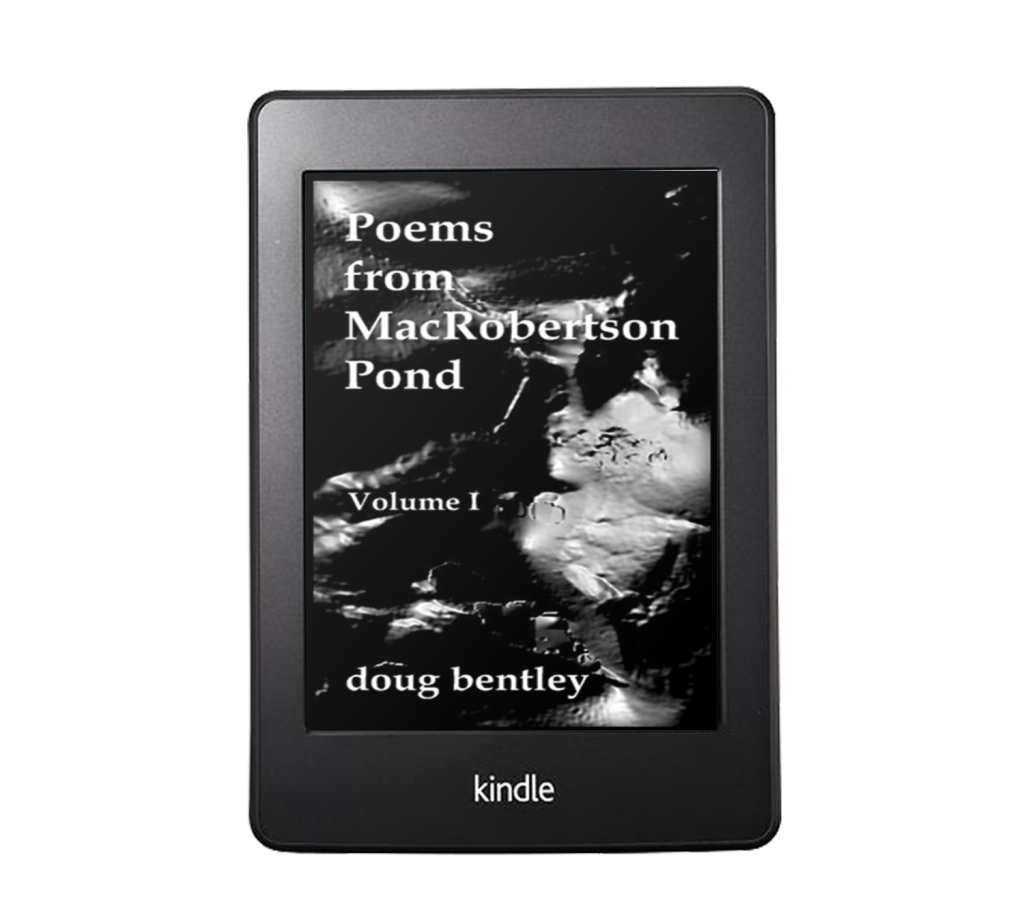
Poems from MacRobertson Pond Vol. 1 is available only at your Amazon Kindle Store.
Get this book at Amazon Kindle Stores here!
An Armchair Explorer’s Delight!
Yearning to uncover the secrets of the world from the comfort of your own home? Embark on a virtual journey to one of the most remote and uncharted areas of the world. Through detailed maps created from the Raised Elevation Model of Antarctica (REMA), this beautifully designed book presents high-resolution topographic maps of the Mac.Robertson Land coast. Here is your chance to see the beauty and mystery of the frozen continent like never before.
This one-of-a-kind book is a must-have for those who crave adventure and have a passion for discovering unknown places. Whether you’re a scientist, explorer, student or simply fascinated with one of the last truly wild places on the planet, this unique collection of maps provides a glimpse into the untamed, untouched world beneath the Antarctic ice as it has never been seen before.
Besides the maps, Poems from MacRobertson Pond Vol. 1 has color photographs alongside historical black and white images of early Antarctic expeditions. Readers will learn about the first explorers to set foot on Mac.Robertson Land and the challenges they faced. Whether you are a seasoned explorer, an avid cartographer, or simply someone who marvels at the beauty of our natural world, this volume promises to be an exhilarating journey.
Get this book at Amazon Kindle Stores here!