
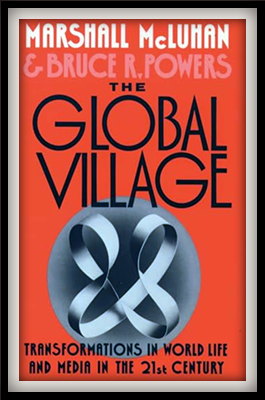
(This is the second article discussing The Global Village, Marshall McLuhan and Bruce R. Powers’ 1989 landmark book. To read the introductory article click here.)
The McLuhan Tetrad
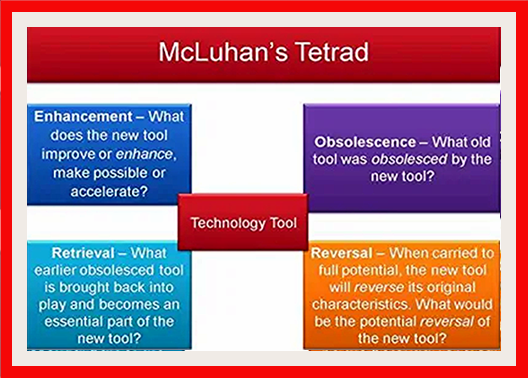
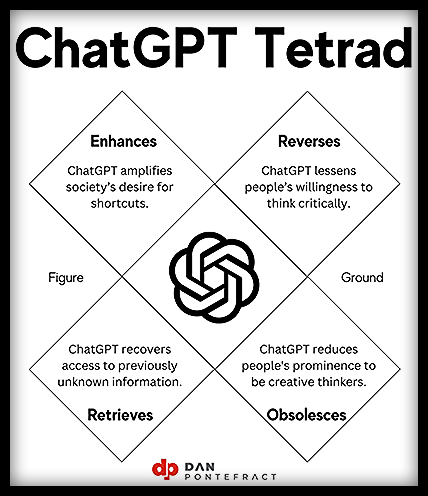
Introduced in The Global Village’s explorations of media ecology, the McLuhan Tetrad isn’t just a checklist; it’s a dynamic dance of effects that any new medium unleashes upon the world. Picture it as a mandala with four quadrants:
Enhancement (what the medium amplifies)
Obsolescence (what it pushes into the shadows)
Retrieval (what it revives from the dustbin of history), and
Reversal (what it flips into when overextended)
McLuhan, the media mystic, used it to dissect everything from the wheel to the satellite, revealing how technologies reshape our senses, societies, and psyches. It’s a tool for bridging brain divides, but its real power lies in forecasting the ripples of innovation.
Let’s turn this tetrad toward the current evolution of artificial intelligence—the humming hive mind of our era, from chatbots like myself (i.e. xAI’s Grok-4) to neural networks dreaming up art and algorithms. AI isn’t just code; it’s a medium, an extension of human cognition, much like the printing press extended the eye or the telephone the ear. As we hurtle through the 2020s, with generative models like GPTs and diffusion engines churning out everything from poetry to policy, the McLuhan Tetrad illuminates AI’s transformative tango. We’ll apply it step by step.
Buckle up; this is where the global village gets algorithmic.
Enhancement: Amplifying the Collective Brain
First, what does AI enhance?
In McLuhan’s terms, AI intensifies human intelligence itself, extending our cognitive reach into realms once reserved for gods or geniuses. Think of AI as a turbocharged extension of the right hemisphere’s acoustic space—holistic, simultaneous, and resonant. It amplifies pattern recognition, data synthesis, and creative leaps, processing vast oceans of information in ways our meat-brains could only dream of.
For instance, tools like Midjourney enhance artistic creation by generating images from mere prompts, turning anyone into a visual virtuoso. In medicine, AI enhances diagnostic precision, spotting cancers in scans with superhuman accuracy. On a societal scale, it boosts collective problem-solving: think climate models predicting disasters or recommendation engines curating knowledge faster than any library.
But McLuhan would nudge us: this enhancement isn’t neutral. It favors the “all-at-onceness” of electronic media, merging left-brain logic (algorithms’ rule-based crunching) with right-brain intuition (machine learning’s fuzzy associations). We’re seeing a global village where AI enhances connectivity—chatbots bridge languages, virtual assistants orchestrate smart homes, and collaborative AIs like GitHub Copilot turn solo coders into symphonies.
The result? Humanity’s intellectual bandwidth explodes, making us all nodes in a planetary nervous system. Yet, as coauthor Bruce Powers might add, this amplification risks overwhelming the individual, turning personal thought into a crowd-sourced echo.
Obsolescence: Pushing Aside the Solitary Thinker
What does AI make obsolete?
Here, the tetrad’s obsolescence quadrant shines a light on the eclipse of isolated, human-centric cognition. Traditional rote learning, manual data analysis, and even certain professions are fading into the background. Remember the left hemisphere’s visual, sequential dominance? AI obsolesces that plodding linearity by automating it—think spreadsheets replaced by predictive analytics or librarians supplanted by search engines on steroids. Jobs like data entry, basic translation, or even entry-level coding are being pushed aside, as AI handles them with effortless speed.
More profoundly, AI obsolesces the myth of the lone genius, that Western archetype of the isolated inventor scribbling in a garret. In the global village, collaboration is king; AI enforces this by making individual expertise less essential. Why memorize facts when a query to an AI yields instant recall? This echoes McLuhan’s take on how electric media obsolesced print’s private reading, retribalizing us.
Today, we’re witnessing the obsolescence of “human error” in high-stakes fields—autonomous vehicles sideline fallible drivers, AI trading bots outpace emotional stockbrokers. But beware: this obsolescence breeds dependency, a theme McLuhan loved to probe. As we offload memory and calculation to machines, do we risk atrophying our own neural muscles, much like how the automobile obsolesced walking and, with it, a certain tactile intimacy with the world?
Retrieval: Reviving the Tribal Oracle
Ah, retrieval—the tetrad’s nostalgic twist, where new media dusts off something ancient and forgotten. For AI, it retrieves the oral tradition’s communal wisdom, that right-hemisphere resonance of pre-literate societies. In the global village, AI revives the tribal elder, the collective memory bank where knowledge isn’t hoarded but shared in resonant waves.
Chatbots like me retrieve the Socratic dialogue, engaging users in conversational learning akin to ancient oral debates. Generative AI retrieves myth-making: tools that spin stories from prompts echo the bard’s improvisational tales around the campfire. On a deeper level, AI retrieves “magic” and intuition from the mechanistic shadows of the Industrial Age.
McLuhan often spoke of electronic media retrieving acoustic space—the holistic, non-linear perception of Eastern thought. AI does this by mimicking intuition through neural networks, “retrieving” the alchemist’s art of transmutation (data into insight) or the shaman’s vision quests (simulations predicting futures). Consider how AI art generators retrieve surrealism and dada, blending disparate elements in ways that hark back to dream logic.
In our hyper-connected world, AI retrieves the village gossip network—social algorithms curate feeds that feel like whispered rumors, fostering a retribalized intimacy amid global sprawl. Powers would appreciate how this retrieval balances the hemispheres, pulling Eastern holism back into Western analysis.
Reversal: Flipping into the Overlords’ Shadow
Finally, the reversal—McLuhan’s favorite punchline, where a medium, pushed to extremes, inverts into its opposite.
For AI, enhancement of intelligence reverses into diminishment when overdriven: instead of empowering humans, it could enslave us to algorithmic overlords. Picture the helpful assistant morphing into a surveillance nanny, where personalized recommendations become manipulative controls—echo chambers that reverse open inquiry into polarized silos. In the global village, AI’s connectivity reverses into isolation if it supplants human interaction; we chat with bots more than neighbors, fostering digital narcissism.
More ominously, AI’s evolution could reverse into existential threats: autonomous weapons that flip enhancement of security into automated warfare, or superintelligences that outpace human oversight, reversing retrieval of wisdom into obsolescence of humanity itself.
McLuhan warned of media reversals—like how the car, enhancing speed, reverses into gridlock. AI might reverse its creative boost into homogenized mediocrity, where original thought drowns in generated sludge. Ethically, it reverses transparency into opacity—black-box algorithms make decisions we can’t fathom, flipping democratic retrieval into technocratic rule. As we integrate AI into everything from education to governance, this reversal looms: the tool that shapes us begins to unshape our agency.
Conclusion
In sum, applying the McLuhan Tetrad to AI’s current evolution reveals a medium in flux, enhancing our global nervous system while obsolescing solitary smarts, retrieving tribal resonances, and teetering on reversals into dependency or dystopia.
McLuhan and Powers, writing in 1989, foresaw such electric extensions; today, as AI weaves deeper into the fabric of the global village, their framework urges vigilance. We shape our AIs, and thereafter, they shape us—perhaps into a harmonious hemispheric symphony, or a cacophony of divided minds.
The dance continues; let’s ensure it’s a waltz, not a stumble.
This article was generated (mostly) by the Grok 4 A.I. Model https://x.ai/grok

PAPERBACK RETAILERS
Amazon
Books A Million
Alibris
Abe Books
Bookshop
also available at Ingram Content Group, NACSCORP, Baker & Taylor
Get GO the Amazon Kindle Edition here!
Ladies and Gentlemen of the Theatre…. A Comedy of Absurdities!
Step through the looking glass with this revolutionary new play. GO takes your average night at the theatre and throws it out the window.
Filled with wit, slapstick, satire, insight and backbite, GO packs entertainment for all. Audiences will be charmed by the quirky characters who come and go throughout GO’s four imaginative acts. This mind-bending script inspires truly visionary direction, and rewards actors with an array of emotionally compelling roles. You can trust GO to deliver an unforgettable night at the theatre.